

The series premiere of Vladimir wastes no time dismantling the fourth wall, establishing a narrative voice that is as unreliable as it is intimate. Adapted from Julia May Jonas’s novel, the opening sequence sets a predatory, darkly comedic tone that suggests this isn’t a standard academic drama. It is a study of power: who holds it, who loses it, and who is willing to take it by force.
Below is a comprehensive breakdown of the season, tracking M’s descent from a prestigious faculty member to a woman willing to burn everything down for the sake of her own narrative agency.
Watch the Trailer

Spoiler warning: The following episode-by-episode recap discusses major plot developments and the ending of Vladimir Season 1.
Navigating the Descent: Chapter Index
Episode 1 “We Have Always Lived in the Castle”
The Cabin and the Cardigan: A Flash-Forward
The episode opens at the end of the line. Our unnamed Protagonist (the narrator, we will call M ) speaks directly to the lens, lamenting a perceived lack of control over her environment. The visual evidence suggests otherwise. Inside a secluded, rustic cabin, she has Vladimir (Leo Woodall) drugged and bound to a chair. The styling is deliberate: he is stripped down to his underwear and a cardigan, a subversion of the “dark academia” aesthetic that usually frames such men.
This cold open serves as a psychological anchor for the rest of the episode. When the timeline resets to six weeks prior, every “innocent” interaction is colored by the knowledge of this eventual basement captivity. It forces the viewer to look for the cracks in her composure from the very first frame.
The Faculty Scandal and the Grocery Store Meet-Cute
Six weeks earlier, the Protagonist is a woman under siege, though she refuses to play the victim. The primary catalyst for the household tension is her husband, John (John Slattery), an academic embroiled in a sex scandal involving six former students. The faculty at their elite college are circling like vultures, demanding his ousting.
While the world judges her husband, the Protagonist’s attention drifts. A chance encounter at a grocery store introduces her to Vladimir. It’s a classic, almost cinematic “meet-cute”, he reaches for a high-shelf item for another woman, but seen through her eyes, it is an act of observation and selection. The chemistry is immediate and one-sided, a silent exchange of glances that she carries back to the university.

The Dinner Party and the Shift in Power
The realization that the “grocery store man” is actually Vladimir Vladinski, a new colleague, shifts the Protagonist’s interest from a passing fancy to a professional mission. The tension during their first faculty meeting is palpable. Vladimir is charming, physically tactile, and, crucially, younger. The introduction of his wife, Cynthia (Jessica Henwick), adds a layer of bitter competition. Cynthia is the “it-girl” of the literary world, a mirror that reflects everything the Protagonist feels she has lost to age and her husband’s infidelity.
The Protagonist’s domestic life is equally fraught. A dinner with her daughter, Sid, and Sid’s older girlfriend, Alexis, devolves into a calculated explosion. By weaponizing John’s scandal during the meal, the Protagonist effectively drives her daughter away. It is an act of self-sabotage that feels like a shedding of skin. She is no longer the “supportive wife” or the “nurturing mother.”
The episode concludes with a shift in the Protagonist’s internal weather. She falls asleep to the sound of Vladimir’s voice via an old interview, a digital stalking that bridges the gap between interest and obsession. When he arrives at her door for their scheduled dinner, the “cozy” facade of the academic life has been stripped away. We are now officially on the road to the cabin.

Episode 2 “The Awakening”
Episode 2 opens with the long-awaited dinner between M and Vladimir. The power dynamic is immediately skewed; M crafts martinis with the precision of a surgeon while waiting for the social validation of Vladimir asking for her book. When the request doesn’t materialize, the silence is deafening. The tension breaks not through conversation, but through a clumsy spill.
As Vladimir attempts to clean his lap, the camera adopts M’s predatory gaze. The focus on his physicality is overt, signaling that M is no longer just a passive observer. The arrival of John interrupts the moment, but it serves a dual purpose: it highlights Vladimir’s genuine admiration for John’s academic legacy, creating a bizarre, uncomfortable triangle where the object of M’s affection idolizes the man she is currently trying to socially excommunicate.
The Art of Academic Blackmail
While Vladimir occupies M’s internal life, her external life is a series of strategic maneuvers to save John from a premature professional death. The introduction of Lila, another former student joining the list of complainants, raises the stakes. John’s hearing with the college board is the guillotine hanging over their domestic life.
M’s approach to the “supportive wife” role is cynical and effective. During a gym session with David, she doesn’t plead for mercy; she utilizes leverage. By bringing up David’s own past indiscretions, she forces his hand to delay the hearing until summer. It is a cold, calculated display of institutional power that proves M is the most dangerous person in the room, a fact the students and younger faculty, like the defecting Edwina, have yet to fully realize.

Hallucinations and the Creative Spark
A recurring motif in this episode is the blurred line between M’s reality and her fantasies. Whether she is daydreaming about Vladimir during a campus tour or imagining an intimate, whispered confession at a faculty mixer, the narrative voice becomes increasingly unreliable. These “episodes” are not just sexual; they are the fuel for her writing. After years of writer’s block, the proximity to Vladimir’s youth and perceived “innocence” acts as a conductor for her own dormant creativity.
The tension between M and Cynthia also takes a sharp turn. The mention of a “mysterious experience” from Cynthia’s past, something involving their young daughter, Phee, suggests that Vladimir and Cynthia’s marriage is not the stable, bohemian ideal M perceives it to be. The friction caused by Vladimir sharing this “personal matter” with M indicates a crack in their armor that M is more than happy to wedge her fingers into.
The Cliffhanger: Who Is in the Pool?
The episode concludes on a high-impact note of physical vulnerability. After a moment of solitary catharsis on her diving board, M is abruptly tackled into the water by an unseen figure.

Episode 3 “ Enormous Changes at the Last Minute”
The cliffhanger from the previous episode is resolved with a splash of cold reality. The “attacker” in the pool is not a vengeful student or a physical manifestation of M’s guilt, but her daughter, Sid. The confrontation is fueled by booze and betrayal; Sid, under the impression that her mother was ignoring her to facilitate John’s affairs, lashed out at what she assumed was one of his students.
This reunion highlights the dysfunction of the family unit. Sid is in a state of freefall, having ended her relationship with Alexis and quit her legal career, yet M’s emotional availability is stunted. M’s lie regarding her knowledge of John’s accusers further isolates her from her daughter, creating a household of secrets where the only shared language is resentment.
The Rebecca Parallel: Mimicry and Sabotage
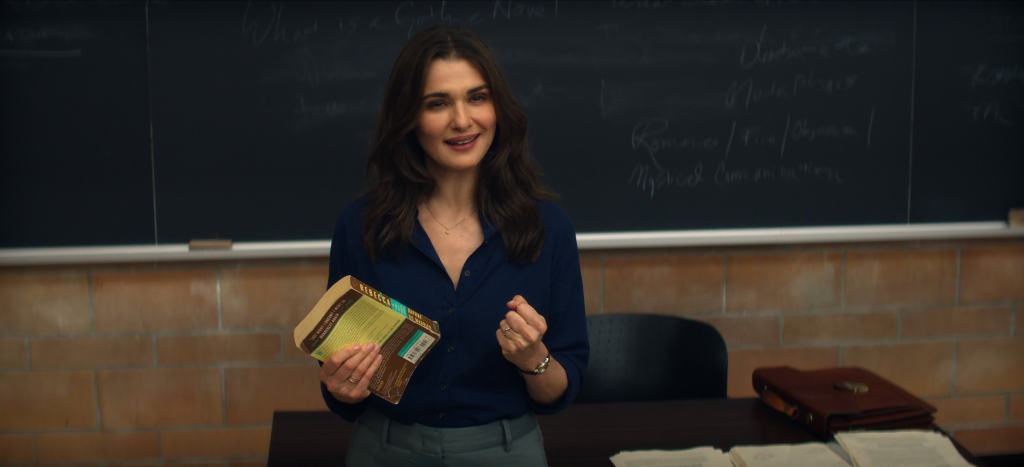
M’s classroom lecture on Rebecca is more than just academic filler; it is a confession. The parallels between the nameless narrator of du Maurier’s novel and M’s fascination with Cynthia are overt. M is not just attracted to Vladimir; she is obsessed with the space Cynthia occupies in his life.
This obsession manifests in increasingly desperate ways:
- The Cubby Theft: In a moment of low-stakes espionage, M steals an envelope addressed to Cynthia from the faculty lounge, a petty crime that signals a loss of impulse control.
- The “Olive Branch”: M attempts to force a friendship with Cynthia by organizing a pool date, a move designed to gain proximity to the couple’s domestic intimacy.
- The Bakery Confrontation: M’s attempt to apologize to Lila backfires spectacularly. By framing Lila’s experience with John as “taking responsibility for her actions,” M reveals her deep-seated misogyny and her inability to view the students as victims.
The Shirtless Catalyst and Cynthia’s Trauma
The planned pool day does not go according to M’s design. Cynthia, sidelined by a “migraine,” stays home, leaving Vladimir to arrive with their daughter, Phee. The image of a shirtless Vladimir in her domestic space serves as sensory overload for M.
However, the episode trades sexual tension for emotional weight during a post-swim drink. Vladimir reveals the dark reality behind their marriage: Cynthia’s “migraine” is a cover for the fallout of a previous suicide attempt. This revelation humanizes Vladimir, transforming him from a mere object of desire into a weary caretaker, while simultaneously giving M a new, tragic narrative to fixate on. Vladimir’s mantra, “choose your hard,” serves as a grim acknowledgement of the compromises required to maintain a facade of normalcy.
The Ending Twist: Displacement of Desire
The episode concludes with a sudden shift in M’s behavior. After a suggestive parting with Vladimir, marked by a lingering touch that borders on the transgressive, M returns to the house and redirects that kinetic energy toward John.
When John asks, perhaps jokingly, if she is in love with their new colleague, M responds with a sudden, aggressive burst of sexual intimacy. This isn’t a reconciliation; it is a displacement. Unable to have the fantasy, she uses the husband she despises as a vessel for the adrenaline Vladimir has stirred in her. It is a cynical, high-impact ending that underscores M’s willingness to use anyone, including herself, to satisfy her impulses.

Episode 4 “Bad Behaviour”
The episode opens with a blunt display of the dynamic between M and John. Their sexual encounter is devoid of intimacy, serves as a mechanical release, and is explicitly fueled by M’s mental projections of Vladimir. John is not only aware of this “New Relationship Energy” (NRE) but treats it with a weary, almost collegiate sense of irony.
This domestic arrangement is further complicated by M’s discovery of Vladimir’s left-behind swimming trunks. Her decision to keep and “scent” them, while promising the audience she will return them, marks a transition from passive admirer to active collector. It is a moment of fetishization that signals M is losing her grip on the “distinguished professor” persona she so carefully maintains.
The Lila File: Retaliation or Rigor?
The primary tension of the episode revolves around a letter from Lila, the student accuser who claims M sabotaged her academic career out of retaliation for John’s affair. M is forced into a desperate search for records to prove her innocence, eventually infiltrating the office of her colleague, David, to find the specific scholarship voting file.
The revelation is damning: M was the tie-breaking vote against Lila. While M maintains the decision was based on academic merit, the optics are disastrous. In the hyper-political environment of a modern university, “merit” is often indistinguishable from “spite” when a spouse is involved.
An Unlikely Alliance: M and Cynthia
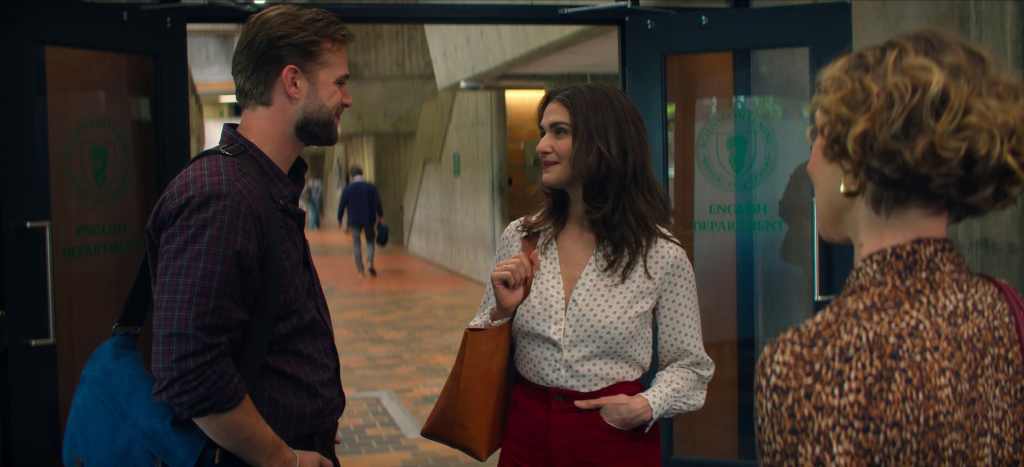
In a narrative pivot, M’s attempt to return the stolen file at 5:00 a.m. leads to a confrontation and an eventual bonding session with Cynthia. The two women find common ground in their shared frustration with the men in their lives. Cynthia reveals the source of her recent conflict with Vladimir: his decision to disclose her history of mental health struggles to the hiring committee.
This shared confidence leads to a radical act of solidarity. Cynthia, reviewing Lila’s file, agrees that the grading was fair and suggests that they destroy the evidence. The image of the two women burning the file is a powerful subversion of their initial rivalry. They are no longer competing for Vladimir; they are conspiring to protect their own stability against a system that judges them for the actions of their husbands.
The Digital Flirtation: Was He Flirting?
The episode concludes with a shift in the power dynamic between M and Vladimir. After M joins a subcommittee specifically to be near him, even going so far as to attend the meeting without underwear, Vladimir cancels at the last minute.
However, the “rejection” is softened by a late-night text. Vladimir sends M a selfie in a tank top, claiming to be engrossed in her novel. His description of his reading style,”slowly… closely… with great attention to detail,” is layered with double entendre. For M, this is the validation she has been seeking. It confirms that Vladimir is not just an object to be watched, but an active participant in the game. Whether his intent is genuine or a calculated move by a junior professor seeking tenure remains the central question as we head into the second half of the season.

Episode 5 “Play It As It Lays”
The episode begins with a moment of generational disconnect. M, spiraling over the ambiguity of Vladimir’s latest text, turns to her daughter, Sid, to decode an emoji. It is a pathetic display of vulnerability that highlights how much power M has surrendered to a man who remains, essentially, a stranger.
However, her internal neurosis is quickly met by external pressure. David, her colleague and former lover, reveals he is aware of her unauthorized entry into his office. M’s attempt to gaslight him, denying she took the Lila file, fails to move him. The stakes are raised when she confesses the truth to Sid: she didn’t just take the file; she and Cynthia burned it. By destroying evidence in an active college investigation, M has moved from academic misconduct into potential legal territory.
The Recommendation Letter and the Ethics of Distraction
M’s professional negligence takes a human toll in her interactions with Edwina. Having promised a recommendation letter for the student, M discovers she missed the deadline entirely. Rather than owning the mistake, she attempts a futile, dishonest persuasion of the admissions office.
The sting of this failure is compounded when she learns that Cynthia, the woman M is both stalking and befriending, stepped in to write the letter instead. This realization that her obsession with Vladimir has made her a “bad actor” in her own classroom prompts a brief moment of clarity, leading M to delete her text history with him. It is a digital purge that proves to be too little, too late.
The House of Mirth and the Classroom Confrontation
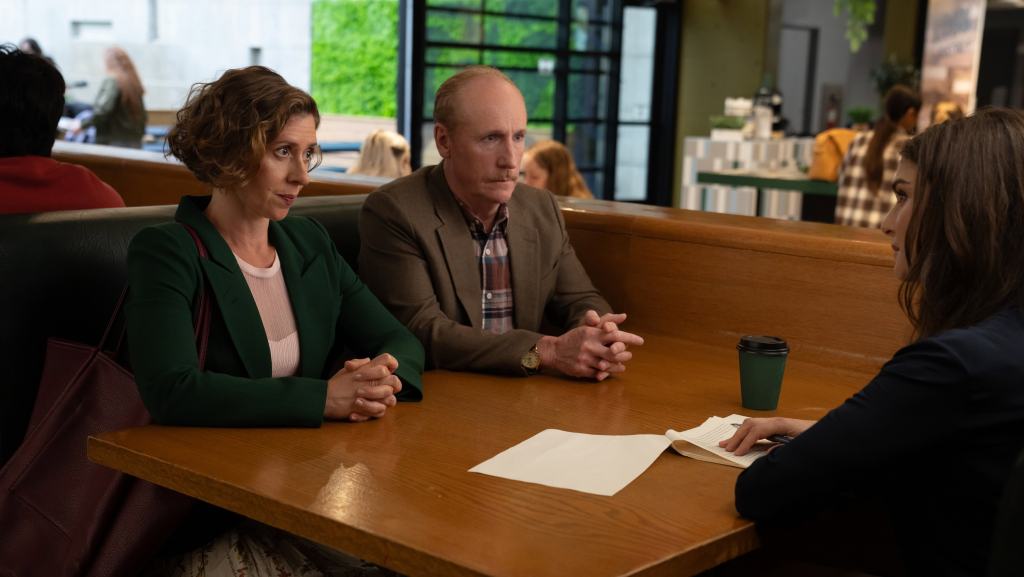
In a sequence that mirrors the Rebecca lecture from earlier in the season, M attempts to find erotic subtext in Edith Wharton’s The House of Mirth. The scene is interrupted by Vladimir, who appears at the back of the room to provide a “subtly steamy” interpretation of the text.
The exchange triggers another of M’s vivid daydreams, but the reality is much harsher. When a student rejects M’s overtly sexual reading of the passage, her defensive response, insisting that they all “have a body”, comes across as predatory and out of touch with modern campus boundaries. She is no longer teaching literature; she is projecting her own thirst onto the curriculum.
The Look of Love and the Suspension
As the episode draws to a close, Vladimir proposes a lunch date to discuss M’s manuscript. Crucially, the date falls on the same day as John’s disciplinary hearing. M’s decision to prioritize Vladimir over her husband’s career survival is the ultimate betrayal of the “supportive wife” facade.
As they part, M leans into a classic romantic superstition: if he looks back, he loves her. When Vladimir does indeed turn and wave, M interprets it as a cosmic confirmation of their connection. However, the “romance” is immediately punctured by institutional reality. David and Florence confront M with a list of student complaints, informing her that she has been officially suspended from teaching.
Episode 6 “Because It Is Bitter And Because It Is My Heart”
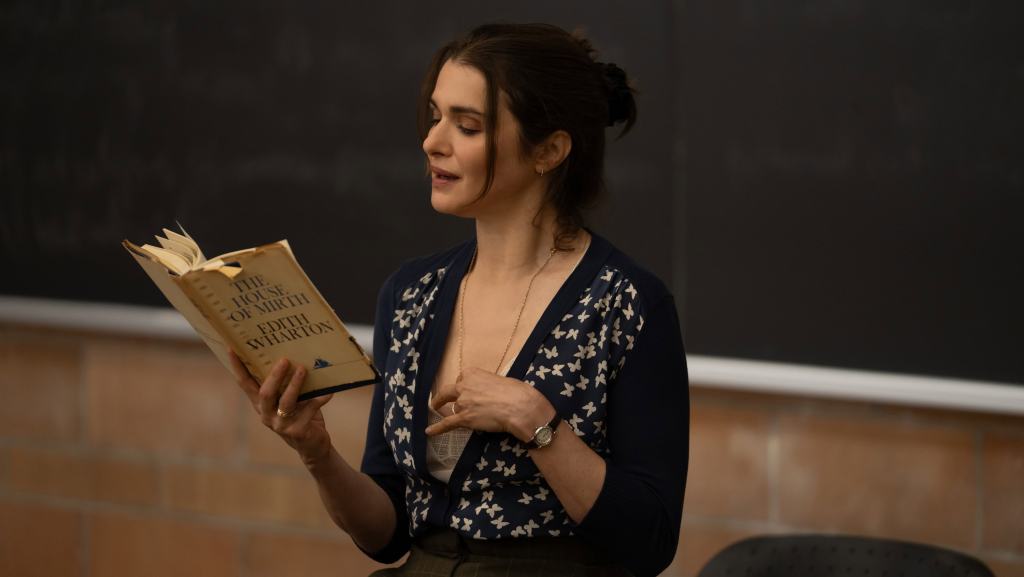
Episode 6 opens with M reeling from the news of her suspension. The administration’s reasoning is twofold: her proximity to John’s toxic brand and her own increasingly erratic classroom behavior. David and Florence offer a “graceful” exit through voluntary stepping down, but M, ever the contrarian, balks. The sting is made sharper by the revelation that Cynthia, her supposed ally and literary rival, would be the one to inherit her curriculum.
M’s reaction is one of petty defiance. From shredding a summons from campus security to smoking in restricted areas, she is intentionally regressing into a “rebel” persona that clashes with her status as a senior faculty member. Even a cold rejection from David, who makes it clear their past physical connection is firmly dead, fails to snap her back to reality. Instead, she retreats further into her sensory fantasies of Vladimir, which are becoming increasingly visceral and distracting.
The Public Confession and the Open Marriage
In a move that mirrors the high-stakes “trial by fire” common in academic thrillers, M transforms her lecture into an open Q&A session. It is a disaster of her own making. By attempting to offer a “nuanced” defense of John, arguing that consensual relationships between adults should not be criminalized regardless of power imbalances, she fundamentally misreads the room.
The admission that she and John shared an open marriage is intended to be a shield, but it becomes a sword for the students. They correctly identify that “consent” is a murky concept when one party holds the keys to the other’s professional future. M’s inability to grasp this shift in cultural morality leaves her isolated, standing in a room full of people who view her not as a scholar, but as an enabler.

The John-Cynthia Connection
The episode’s mid-point introduces a classic noir element: the tail. M follows John on one of his evening excursions, only to witness an intimate meeting and a hug between her husband and Cynthia. This discovery recontextualizes everything. Is the bond M felt with Cynthia real, or was it a tactical move by Cynthia to stay close to the epicenter of the scandal?
This revelation shatters M’s sense of control. She has spent the season trying to manipulate the pieces on the board, Lila, the college president, the students, only to find that her husband and her “friend” might have their own separate alliance.
The Ultimate Choice: Skipping the Hearing
The episode concludes on a note of total abandonment of duty. On the morning of John’s official hearing, the event M has spent weeks stressing over, she chooses to sit in her car for an hour, waiting for Vladimir.
By deciding to have lunch with Vladimir instead of supporting John and Sid at the hearing, M has finally crossed the Rubicon. She is no longer just a woman having a mid-life crisis; she is actively sabotaging her family’s last chance at a clean break. The “look back” from the previous episode has led her to believe that Vladimir is her escape hatch, but as they drive away from the hearing, the cost of that escape is becoming dangerously high.

Episode 7 “ Everything That Rises must Converge”
Episode 7 begins with a deliberate subversion of the audience’s expectations. While Sid and John wait in agony for M to appear at the disciplinary hearing, she is in a car with Vladimir. The staging is intentionally provocative, her head in his lap, only to reveal she is merely adjusting his seat. It is a wink to the audience: the “gutter” is exactly where M’s mind has moved permanently.
As they drive further from the university, M ignores a barrage of frantic texts. The power dynamic shifts during their lunch; M is no longer the mentor, but the curator of a fantasy. She manipulates the environment, lying to waitstaff about Vladimir’s birthday just to extend their time together. Vladimir, for his part, seems content to play along, finding refuge in M’s passionate intellectual validation of his work while his own domestic life with Cynthia remains a source of unspoken “distraction.”
The Hearing: A Different Narrative
While M and Vladimir discuss the “Wish I Wrote” (WIW) notes in her manuscript, the hearing back on campus is dismantling the version of John that M has spent years protecting. The accusers present a cohesive, devastating portrait of predatory behavior that Sid, acting as John’s last line of defense, cannot mitigate.
The contrast is stark:
- On Campus: The cold, hard reality of institutional accountability.
- In the Car/Cabin: A wine-soaked, intellectualized vacuum where M attempts to rewrite her own story.

The Cabin Sequence: From Fantasy to Felony
The transition to the cabin marks M’s total break from the “distinguished professor” archetype. The atmosphere is thick with the “dark academia” aesthetic, heavy sweaters, scotch, and annotated books, but it is curdled by M’s desperation. When Vladimir discovers his stolen swimming trunks in her bag, he isn’t repulsed; he is intrigued, a reaction that only emboldens M’s delusions.
The shift from a romantic tryst to a kidnapping is abrupt and clinical. After a swim in the lake, M briefly considers ending the crush and returning to her life. Instead, she chooses the “nuclear” option. Using the pills stolen from the president’s house in the previous episode, she drugs Vladimir’s drink.
The Frame-Up and the Final Reveal
As the drugs take hold, M’s caretaking becomes carceral. She dresses a semi-conscious Vladimir in one of John’s sweaters, a literal attempt to replace her husband with a younger, “better” model, before zip-tying and chaining him to a chair.
In a final act of calculated malice, she uses Vladimir’s phone to send a fabricated text to Cynthia, claiming he is cheating on her with John. By doing so, she destroys Vladimir’s marriage and John’s remaining shred of credibility in one stroke, before drowning the phone to sever his connection to the outside world. The episode ends where the series began: M, finally in “control,” sitting at the feet of her captive, writing the story she has forced into existence.
Episode 8 “Against Interpretation
Episode 8 picks up exactly where the series began: the “tease” of a captive Vladimir. M’s immediate reaction to his panic is a masterclass in psychological manipulation. She reframes his drugging and kidnapping as a consensual “domination” fantasy that he simply doesn’t remember. It is a bold, predatory lie, yet Vladimir, perhaps out of a desperate need for safety or a twisted intellectual curiosity, chooses to accept her denial.
The morning after brings a strange, domestic truce. Vladimir, seemingly refreshed by “the best sleep in months,” settles into the cabin. However, the intellectual cat-and-mouse game continues. He reveals he saw the texts M sent to Cynthia via his laptop, effectively catching her in the act of sabotage. Yet, in a testament to the show’s warped power dynamics, he stays. The “professor-student” roleplay they eventually engage in isn’t just a game; it is the fundamental language of their relationship.
The Hearing’s End: A Quiet Dismissal
Back at the university, the high-stakes hearing concludes not with a bang, but a bureaucratic whimper. Lila’s testimony is a poignant moment of clarity; she identifies John’s predatory nature but refuses to vilify M, calling her a “good teacher.” It is a rare moment of grace in a season defined by spite.
The legal resolution is equally cynical. John is barred from teaching but retains his pension, a “soft landing” that infuriates the student body but preserves the status quo for the elite. Sid, sensing the rot at the core of her parents’ reconciliation, departs for the city, effectively severing her ties to the toxic environment M has fought so hard to maintain.

Fantasy Becomes Reality: The Sexual Conquest
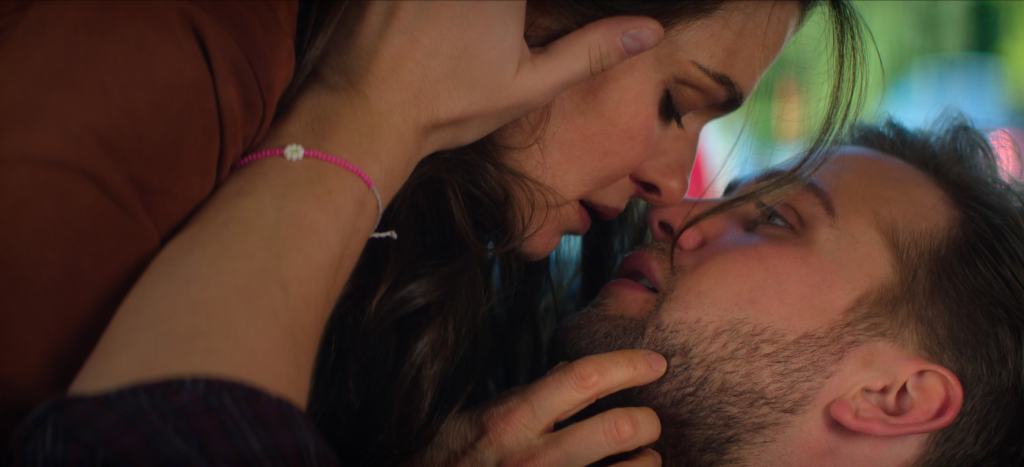
The tension that has simmered since the grocery store in Episode 1 finally boils over. After a season of vivid, intrusive daydreams, M and Vladimir finally have sex. For M, this is the ultimate act of “agency.” However, the aftermath is telling: she immediately sends him to the guest room so she can write. The act itself was merely research, a final chapter for the legal pads she carries like a religious relic.
The arrival of John at the cabin shatters the illusion of M’s romantic triumph. He reveals the truth about his meetings with Cynthia: they weren’t having an affair in the traditional sense, but were abusing Adderall to write together. For Vladimir, this is the true betrayal. Cynthia, an addict he believed was sober, has been using John as a facilitator for her relapse because he makes her feel “normal.”
The Fire and the Fiction: Can We Trust the Narrator?
The series concludes with a literal and metaphorical burning of the bridges. As a fire breaks out in the cabin, M faces a split-second choice. She doesn’t reach for her husband or her lover; she grabs her manuscript.
As she stands outside, cradling her notes while the men she “loves” are trapped behind a jammed door, the narrator’s voice becomes overtly meta. She claims she called 9-1-1 and that everyone survived. She claims she and Vladimir both wrote books about the experience, and that hers performed better.
But can we believe her? Throughout the season, M has proven herself to be a master of the “nuanced” lie. By suggesting that John and Vladimir were merely “characters” in her story, she casts doubt on every event we’ve witnessed. The cabin fire may be the only honest thing that happened, a final, cleansing destruction of the evidence.
The Poster