

The Netflix survival thriller Thrash concludes with a sequence of events that redefines the “natural birth” trope, as the protagonist, Lisa Fields, delivers her child while submerged in floodwaters. The film ends on a tension-filled note, with a secondary, more powerful storm system appearing on radar as the survivors wait for rescue.
This Thrash movie recap explores the narrative beats of the Annieville disaster and the specific biological defenses used to ward off the shark incursion.
The film uses a flash-flood scenario in a small town to trap its characters in increasingly claustrophobic settings. While the primary threat is the rising tide and the bull sharks within it, the story ultimately shifts into a study of survival instincts, particularly regarding the protective behavior of the film’s unexpected apex predator.

Before Reading The Recap, Watch the Trailer

Flash floods and the sudden arrival of Hurricane Henry
The story kicks off in Annieville, a town largely unprepared for the speed of Hurricane Henry. We’re introduced to Dakota, a woman whose agoraphobia keeps her tethered to her home even as the weather turns. Her uncle, Dale, is a marine researcher tracking a shiver of sharks that he fears will be displaced by the storm. This setup effectively establishes the two-pronged threat: the uncontrollable nature of the weather and the predatory element waiting beneath the surface.
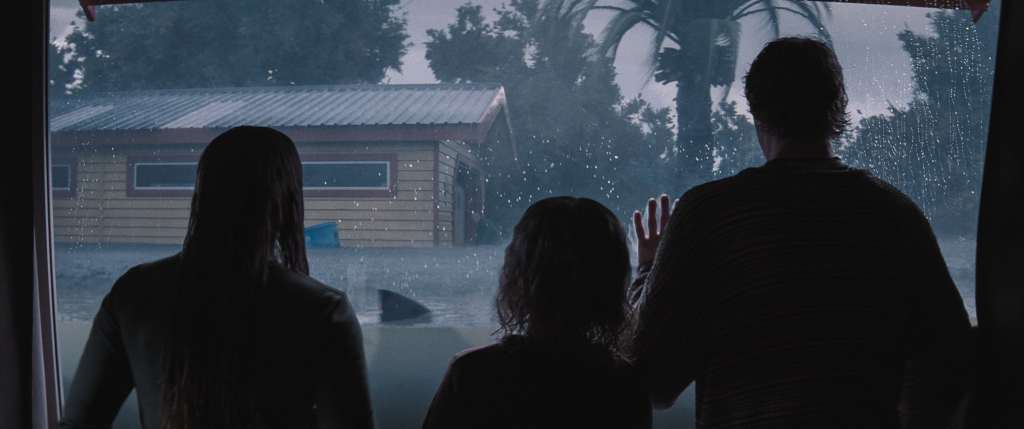
As the streets turn into rivers, Lisa Fields, a pregnant woman visiting from New York, finds herself trapped in her car by a fallen tree. The water rises so rapidly that the first levels of most homes are submerged within minutes. The early sequences highlight the sheer power of the water, which acts as a delivery system for the bull sharks now patrolling the residential areas.

The basement rifle and the Olsen siblings’ stand
While Dakota watches the carnage from her upper window, the Olsen foster siblings, Ron, D, and Will, are forced onto their kitchen countertops. Their foster parents, the Olsons, attempt to flee in a truck but are intercepted by sharks. This moment serves as a turning point for the kids, especially after Ron realizes their foster father, Billy, had been embezzling their government checks.
Ron initiates a high-stakes plan to distract the sharks with raw meat so he can dive into the flooded basement. Instead of just finding Billy’s rifle, he uncovers a suitcase of dynamite. The narrative shift here moves from pure survival to active resistance, as the children decide to stop being prey and start using the tools left behind by their negligent guardians.
Lisa’s water birth and the Great White intervention
The emotional center of the film is Lisa’s labor, which begins just as the house she was sheltering in collapses. In what is easily the most visceral scene of the movie, Lisa gives birth while swimming toward the surface of the flooded room. The birth itself is successful, but the resulting blood in the water immediately attracts a trio of bull sharks.
Just as it looks like Lisa and her newborn are lost, a “lone pregnant Great White” that Dale mentioned earlier, nicknamed Nelly, intervenes. Dale had previously noted that a Great White might attack bull sharks to protect its own territory or young. Nelly’s arrival isn’t a “heroic” act in the human sense, but a biological one, as she takes out the bull sharks and gives Dale enough time to arrive with his specialized equipment.

Radar warnings and the Category 5 threat
The film’s resolution sees Dale using an electrical vibrating shocker to drive away the remaining predators, finally reaching Dakota and Lisa. Meanwhile, the Olsen siblings manage to blow up one of the sharks and escape in a partially submerged car. While the sun begins to rise, the sense of safety is fleeting.
The final scene cuts back to the coast, where Greg, a weather monitor, views a new radar signature. A massive storm, Hurricane John, is already a Category 5 and heading straight for the survivors’ location. The implication is that the first wave was merely a precursor to a much larger disaster, leaving the characters in the path of an even more dangerous “Category 6” event.

FAQ
- Why did the Great White shark save Lisa? In the film’s lore, the Great White (Nelly) was also pregnant. Dale explains that apex predators will often attack other sharks to defend their territory or eliminate competition, which inadvertently saved the humans.
- Do the Olsen siblings survive in Thrash? The siblings escape their home in a car after blowing up a shark with dynamite. However, their car is partially submerged and stalled in floodwaters, leaving their ultimate fate uncertain as a second storm approaches.
- What was the “vibrating shocker” Dale used? It was a piece of marine research equipment designed to emit electrical frequencies that mimic injured prey or disrupt a shark’s sensory organs, effectively clearing the immediate area of predators.
Key Details
- Release Date: April 11, 2026
- Runtime: 98 minutes
- Cast: Dakota (Lead), Lisa Fields, Dale (Marine Researcher)
- Creators: Netflix Original Production
- Source Material: Original Screenplay