Netflix’s Monster anthology has redefined how true-crime stories are dramatized.
After the global phenomenon of Dahmer – Monster: The Jeffrey Dahmer Story (2022) and the follow-up Monsters: The Lyle and Erik Menendez Story (2024), creator Ryan Murphy returns with a third chapter: Monster: The Ed Gein Story.
This season examines one of America’s most infamous killers, Ed Gein , a lonely Wisconsin handyman and grave robber whose crimes inspired horror classics including Psycho, The Texas Chain Saw Massacre, and The Silence of the Lambs. Over eight episodes, the series tracks his childhood under a fanatically religious mother, the murders that horrified his small town, and the cultural aftershock his actions unleashed.
Below is a full episode-by-episode recap of all eight chapters, plus an ending explained section that breaks down what the finale means.
Spoiler warning: Key plot points, character deaths, and the final reveal of Ed’s fate are discussed in detail.
Episode 1 — “Mother”
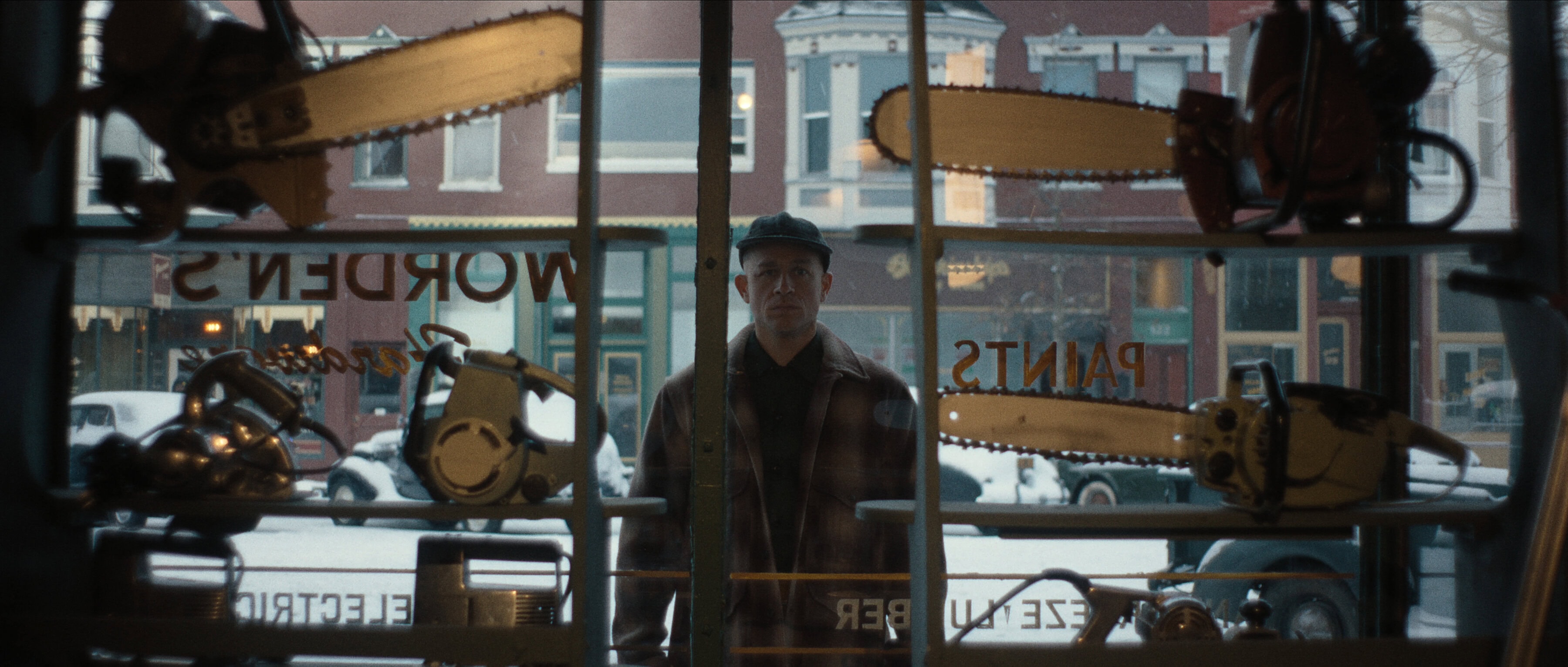
The season begins on a bleak winter morning in rural Wisconsin. We first meet Ed Gein, a quiet, socially awkward man tending chores around the family’s isolated farm. His life revolves almost entirely around his devout and controlling mother, Augusta, whose strict religious worldview condemns sexuality and contact with “sinful” women. The episode immediately sets up how deeply this upbringing shapes Ed’s inner world.
Later that day, Ed sneaks into a nearby house to spy on two young women, Adeline and Madison, as they try on lingerie. When they hear him, he panics and flees, a moment that captures his stunted, shame-ridden curiosity. Back home, Ed performs a ritualistic act: slipping into his mother’s undergarments, fashioning a rope noose, and engaging in sexual self-punishment. Augusta catches him and reacts with fury, reminding him that any woman outside her moral code is a “jezebel,” especially Adeline.
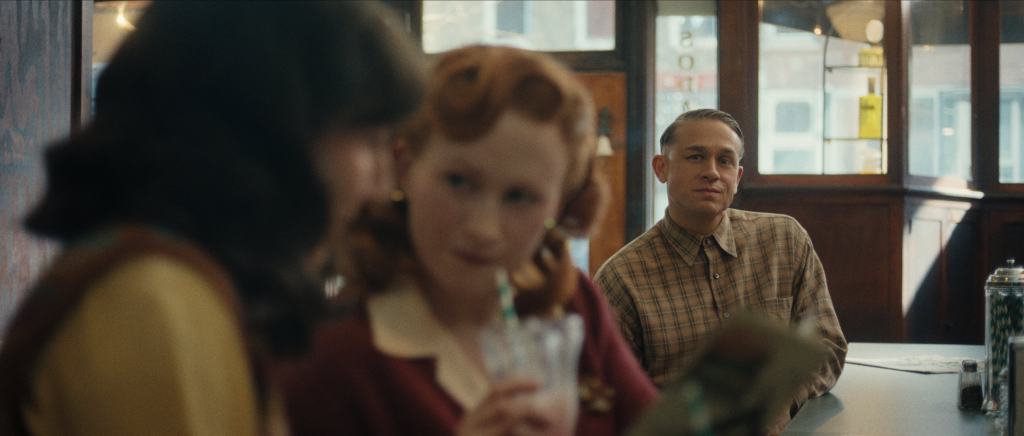
That night at a local diner, we learn Ed and Adeline actually know each other. Adeline, fascinated by dark history and photography, shares disturbing photos of Nazi concentration camp victims and a sensational magazine about war criminal Ilse Koch, infamous for crafting human-skin keepsakes. Ed is unsettled but also visibly drawn to the grotesque images, planting seeds for the obsession that will define him.
The turning point comes with his older brother Henry. Tired of Augusta’s domination, Henry plans to leave and urges Ed to do the same. Ed, terrified of abandoning his mother’s control, lashes out: he strikes Henry with a log and leaves him for dead. In a chilling beat, we see that Ed briefly hallucinates Henry recovering and threatening to expose him, but the next day Henry’s body is lifeless. Ed burns the corpse under brush and convinces Augusta it was a tragic accident. Police suspect little, though the morgue quietly notes signs of asphyxiation.
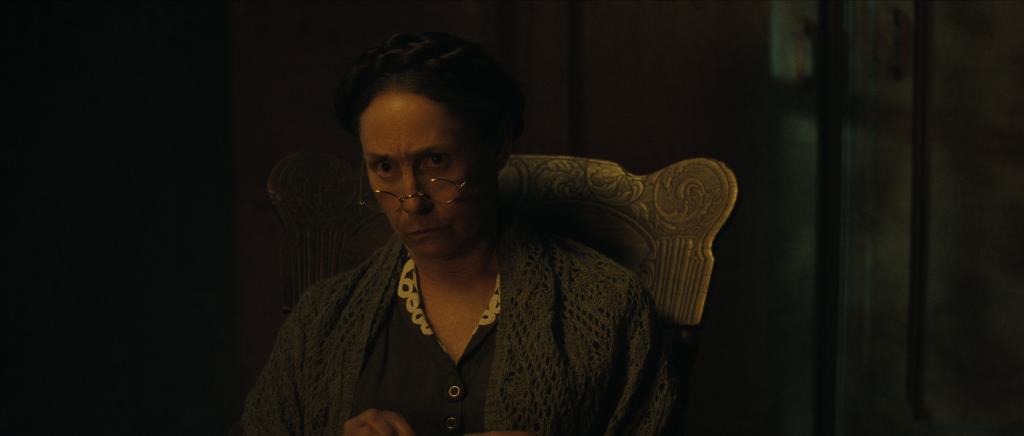
Soon after, Augusta suffers a stroke and dies from a heart attack. Ed, untethered, begins hearing her voice urging him to keep her close. He tries digging up her grave but fails, then exhumes a nearby woman instead, cleaning the body and seating it in Augusta’s rocking chair. The episode ends with Ed staring lovingly at the corpse, grief and madness fully merging.
Episode 2 — “Sick as Your Secrets”
Episode 2 picks up with Ed’s mind already cracking under grief and repression. We open on a disturbing hallucination: Jewish concentration-camp prisoners swarm toward him, a night terror rooted in the grotesque Nazi images he’s been collecting. This cold open blurs the line between his fantasies and reality, a thread the series will pull harder later.
The story then shifts to 1959 Hollywood, where director Alfred Hitchcock dines with his wife Alma Reville and novelist Robert Bloch, author of the book that will become Psycho. Over dinner they discuss Ed Gein’s childhood, his fixation on corpses, and the way cruelty can echo through art. Bloch explains that Ed’s fascination with death started young and was fed by sensational pulp, including the lurid magazine The Bitch of Buchenwald about Nazi war criminal Ilse Koch. The meeting sets up how Gein’s real crimes will soon inspire one of cinema’s most iconic villains, Norman Bates.
Back in 1950s Wisconsin, Ed’s relationship with Adeline deepens but remains strange. She dreams of leaving for New York to shoot crime scenes; he’s awkwardly enthralled by her morbid curiosity. During a date, Ed admits he’s made a bowl from a human skull, she laughs it off as gallows humor. When he invites her to meet his mother, the night turns horrific. Adeline finds Augusta’s room frozen in time, with a corpse sitting in her rocker. Realizing this is not a macabre joke, she bolts from the house in terror.
Shaken, Ed heads to a local tavern to drink. The friendly talk with bar owner Mary Hogan curdles when he suddenly pulls a shotgun and kills her, hauling the body back to his farmhouse. Meanwhile, police begin sniffing around after Mary’s disappearance, but the small-town force still sees Ed as an odd but harmless recluse.
The hour closes by returning to Hitchcock. As Psycho moves from book to film, Hitchcock coaches star Anthony Perkins in how to embody Norman Bates. He even shows Perkins grisly keepsakes meant to mirror Ed’s trophies, the connection between Gein’s crimes and the emerging horror classic locks into place.
Episode 3 — “The Babysitter”
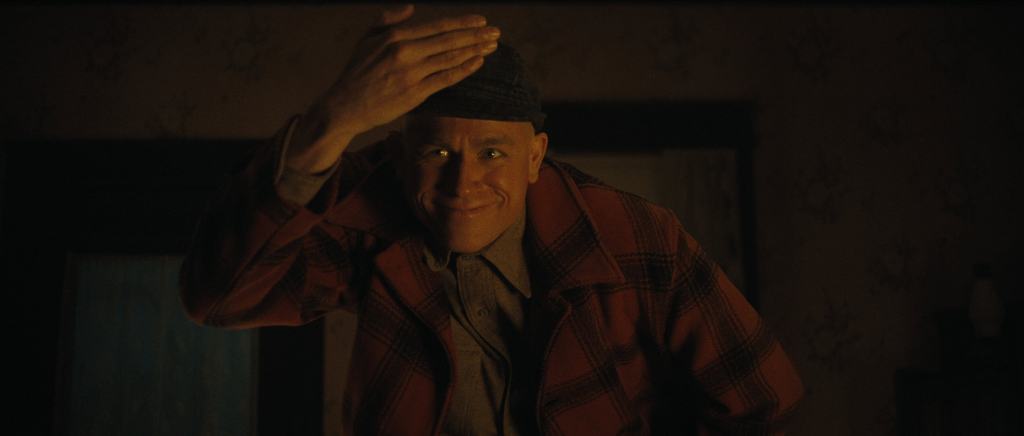
Episode 3 opens with an image that’s part grotesque theater, part psychological breakdown: Ed Gein dances alone in his farmhouse, dressed in his dead mother’s clothes and wearing a crude mask stitched from human skin. A knock at the door shatters the moment; local police have arrived to question him about the disappearance of Mary Hogan, the bar owner, whom he killed the previous night.
Ed plays the grieving, awkward son perfectly. He tells the officers his truck wouldn’t start, so he stayed home with Augusta. They hint someone saw his vehicle near Mary’s bar, but Ed leans into his reputation as the odd but dutiful son and sways their suspicion. Once they leave, he seems almost relieved at how easily charm and pity can camouflage horror.
Later, Ed bumps into Adeline at a diner. Despite running from his house in terror before, she softens toward him; the small town seems to pull them back together. She shows him photos of a transgender woman, a topic both taboo and fascinating in 1950s Wisconsin, and Ed is visibly intrigued by the idea of reshaping identity. He promises a “surprise” for her later, his warped imagination clearly firing.
That night he prowls the cemetery again, but rather than exhuming an entire corpse he simply pries a ring from a fresh grave. In one of the show’s eeriest sequences, Ed proposes to Adeline right there among the headstones. To his delight, and the audience’s horror, she accepts, seemingly blind to the darkness he’s steeped in.
The episode also threads in the Hollywood storyline: Psycho’s massive success traps star Anthony Perkins in the role of Norman Bates. Studio executives push for a sequel while Perkins struggles privately with sexuality and the conversion therapies of the era, showing how Gein’s legacy shapes not just horror but the people making it.
Everything turns darker when Ed babysits local children. He treats them to gruesome “games,” even handling a decomposed head to frighten them. The parents’ furious reaction hints that the small town may finally start questioning this “quiet” man. But Ed’s fantasy life only grows: later that night, he abducts Evelyn, a young babysitter recently back from a polio hospitalization, and kills her in his barn, forcing Augusta’s preserved corpse to enact the violence.
The episode ends with that hammer blow, signaling that Ed’s private horrors are escalating beyond graveyards into living victims.
Episode 4 — “Green”
Episode 4 picks up where the last hour left off: Adeline has wandered into Augusta’s bedroom and found the rocking chair occupied not by a stern matriarch but by a decaying corpse. Her scream pierces the quiet farmhouse, jolting Ed Gein as he prepares the body of his latest victim, Evelyn, in the barn. In a panic, Adeline bolts home with Ed close behind. She locks the front door, but he slips inside through another entrance.
Cornered in her bedroom, Adeline demands an explanation. Ed calmly admits the body isn’t Augusta’s but a woman he dug up. Instead of reacting with horror, Adeline surprises both Ed and the audience: she’s curious rather than repulsed. She even asks how it felt to exhume someone. Her fascination, mixed with her own dark streak, cements their warped connection.
Soon after, Ed drifts back into the wider town and sets his sights on Bernice Worden, the lonely, middle-aged owner of the local hardware store. Their first meeting is almost sweet: Ed chats about buying lime, charms her into lunch, and listens as she confesses to an affair with a married man. On a skating date they share wine, intimacy, and tentative plans for Ed to move in with her. It’s the first glimpse of Ed trying to build a life beyond Augusta’s shadow, but the illusion won’t last.
Back at the farmhouse, Ed suffers a terrifying hallucination of Augusta. She calls Bernice a harlot, warns of disease, and demands he remain faithful to her memory. The pull of this phantom mother proves stronger than Bernice’s offer of love. The next day he returns to the store, breaks things off, and when Bernice protests, he shoots her in the head. He drags the body to his barn, mutilates it, and hangs it upside down, one of the show’s most graphic sequences.
When he shows Adeline the scene, she’s disturbingly fascinated, leaning into her own morbid curiosity rather than recoiling. In a chilling coda, the narrative shifts back to filmmaking history: young director Tobe Hooper, frustrated that Hitchcock’s Psycho only grazed true horror, begins shaping an even more visceral film, the one that will become The Texas Chain Saw Massacre. Ed’s real crimes continue seeping into pop culture.

Episode 5 — “Ice”
The fifth episode pivots sharply toward Adeline, showing how her own life unravels while Ed’s darkness deepens. It opens on a cold Wisconsin morning where Adeline sleeps with a local farmhand, Randy, a blunt signal that her attachment to Ed has frayed. She returns home to clash with her domineering mother, who wants her to settle into domestic life. Adeline dreams bigger: she wants out, and she wants New York.
Later, over a tense restaurant meal, Adeline tells Ed Gein she’s leaving for a job interview as a crime-scene photographer, the same ambition she mentioned earlier in the series. She urges him to come with her, but he is hesitant, chained by fear and his devotion to Augusta’s memory. On the ride back, their fragile romance collapses. Ed pushes for sex and a traditional family; Adeline refuses both. Her rejection is cruel in its own way: she suggests, half-taunting and half-serious, that if no living woman wants him, maybe he should sleep with a corpse.
This offhand cruelty triggers one of the series’ most grotesque scenes. The pair drives to a graveyard, exhumes a fresh body, and Ed has intercourse with the corpse twice. The moment is filmed without sensationalism but underscores how warped and desperate their bond has become.
Adeline then heads to New York chasing her dream, but the city devours her. Her cheap, unheated flat is freezing, and the job interview goes poorly; the interviewer doubts her skills and undercuts her confidence. Alone and furious, she confronts her landlord about the cold. When dismissed, she snaps, removing a high heel and beating the woman to death in a sudden, shocking outburst. Adeline robs the body and flees, broken and now a killer herself.
Returning to Wisconsin in defeat, Adeline finds no comfort. Her mother cruelly admits she never wanted her. Seeking solace, she visits Ed, suggesting sex to rekindle what they had. But Ed recoils, telling her she’s “too warm.” The comment lands like a hammer: he has grown incapable of intimacy with the living. To prove devotion, Adeline climbs into a bathtub of cold water while Ed dumps ice over her, an act as chilling metaphorically as it is literal.
The hour ends here, cementing how trauma has twisted both of them beyond return.
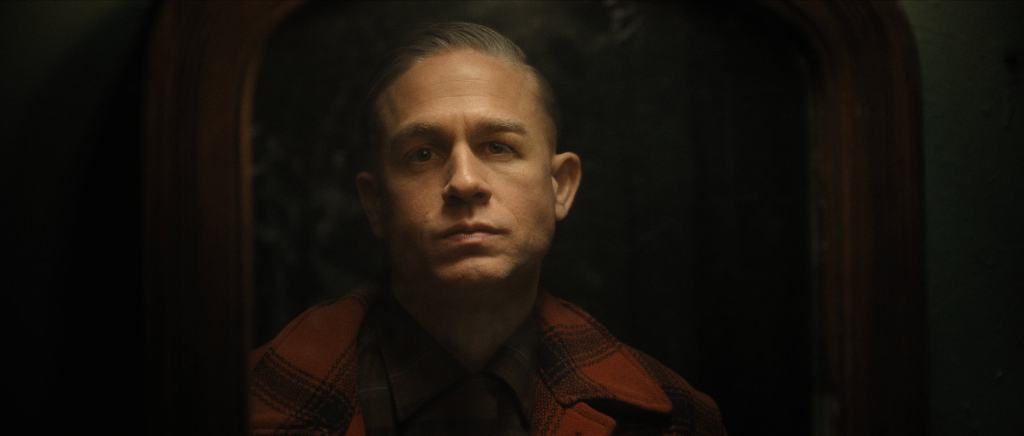
Episode 6 — “Buxom Bird”
Episode 6 finally cracks open the secret horror of Ed Gein’s world. It begins with a bittersweet flashback: Deputy Frank Worden asks his mother, Bernice, to host Thanksgiving dinner. She resists but relents, showing a softer, more personal side before the story fast-forwards to the grim present, Bernice has vanished, and Frank is desperate for answers.
Frank teams with Sheriff Art Schley to retrace her steps. They arrive at her hardware store, where the signs of violence are faint but chilling: blood spattered across walls and floorboards, a shop in eerie silence. Frank refuses to believe the blood could belong to his mother; Schley tries to steady him but is clearly worried. Outside, Schley questions a neighbor while Frank wanders deeper into the store. In a back room he spots a package addressed to Ed Gein, an unsettling thread tying the mild-mannered local handyman to his missing mother.
The officers decide to check Ed’s farmhouse. What they find is a waking nightmare. The house is filthy and crawling with flies. Human remains litter the space: bowls carved from skulls, furniture upholstered with human skin, masks fashioned from faces. The show presents the scene quietly, without gore for shock’s sake but with an unshakable dread. Frank’s search takes him to the barn, where he discovers Bernice’s mutilated, headless body hanging like butchered meat. The moment is devastating, a son stumbling upon proof his mother’s final moments were unthinkably cruel.
Ed pulls into the driveway mid-investigation. Sheriff Schley confronts him while Frank, overcome with grief and rage, attacks him. Officers drag Frank away as Ed is arrested. It’s the first time the series shows him cornered by reality.
At the station, Schley interrogates Ed. Calm but evasive, Ed admits to grave robbing and making “keepsakes” but denies murdering anyone, even under a polygraph. Schley suspects he’s responsible for far more deaths, possibly “up to 200,” but Ed’s foggy memory and dissociation frustrate efforts to pin the murders down.
Meanwhile, Adeline tries to capitalize on the media frenzy by selling her connection to Ed, but reporters aren’t interested in her. She’s reduced to a footnote in a story she helped fuel.
The episode closes on grief. Frank fights to reclaim his mother’s body from the morgue, which wants to study and piece her remains together. After finally securing her for burial, he joins Schley for Thanksgiving dinner, but when Schley carves the turkey, Frank flashes to Ed dismembering Bernice. Trauma has shattered any sense of normalcy.
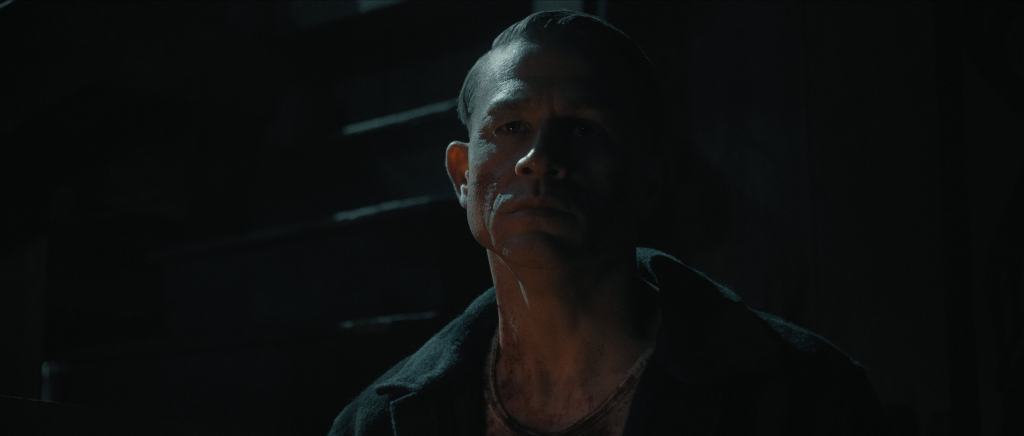
Episode 7 — “Ham radio”
Episode 7 finds the story at its bleakest point. Ed Gein is no longer facing trial, psychiatrists have ruled him legally insane, and he’s committed to a state mental hospital instead of prison. While Ed drifts deeper into delusion behind locked doors, Deputy Frank Worden is unraveling on the outside. Still haunted by the discovery of his mother’s butchered body, Frank drinks heavily and struggles to function at work.
Sheriff Art Schley invites Frank into his office, hoping to talk him out of a destructive plan: Frank intends to sue Ed’s estate and auction off his belongings as a form of justice and financial retribution. Schley warns that turning Gein’s gruesome keepsakes into public spectacle feels wrong, but Frank is beyond persuasion. Selling the horrors might be the only control he has left.
The episode then pivots to the asylum, where Ed has settled into a strange, almost childlike routine. A friendly nurse nicknamed Salty tells him he’s earned a small sum of money from the sale of his property and offers to buy him things if he shares a cut. Ed eagerly requests ham radios, believing they will let him speak with his idols: Nazi criminal Ilse Koch and American entertainer Christine Jorgensen, one of the first widely known transgender women.
At first the plan seems to work. Ed “chats” with Ilse, who insists on her innocence and bonds with him over their shared confinement. She urges him not to let the world label him a monster before hanging herself in prison. Later he “calls” Christine, seeking guidance about his gender confusion. Dressed in a suit of human skin, Ed tells her about his body obsessions. Christine, disturbed but compassionate, tells him he isn’t transgender but a gynephiliac, someone with an overwhelming sexual fixation on female anatomy. Ed feels even more lost.
Then the narrative cracks wide open: the new head nurse, Roz, cuts off his freedoms, and Ed’s hallucinations spiral. He attacks Roz with a chainsaw one night, but the next morning she’s alive and well. Panicked, Ed confesses to the hospital doctor, who delivers a crushing truth: the radios never worked; Ilse and Christine were voices in Ed’s own mind. The doctor diagnoses him with schizophrenia, explaining that the voices and urges that fueled his grave robbing and murders came from this untreated illness.
The hour ends with rare tenderness. The doctor promises medication to quiet the voices and help Ed feel whole. Ed sobs, hugs Roz, and swallows his first pill, a fragile moment of peace after a lifetime of chaos.
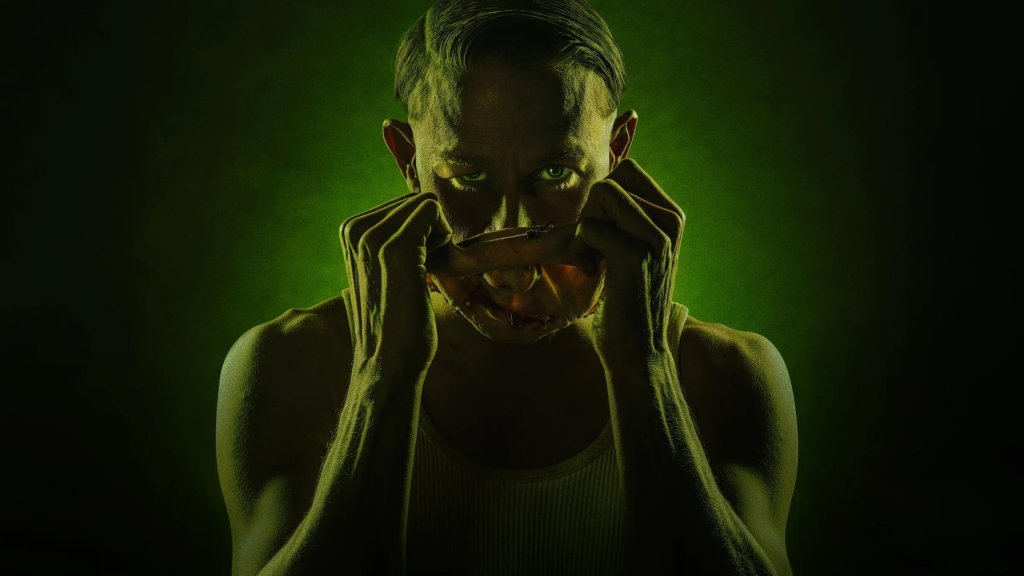
Episode 8 — “The Godfather”
The series finale jumps ahead to the 1970s and shows how Ed Gein, now medicated and subdued inside a Wisconsin mental hospital, becomes a reluctant resource for law enforcement,even as his own life nears its end.
The episode opens far from Wisconsin, with a chilling scene in Washington State: a seemingly helpful man lures two young women into his car, strikes one unconscious, and ties them up. He is revealed as Ted Bundy, already escalating his predatory crimes. His assault and post-mortem desecration of victims mirror Ed’s own past, drawing a grim thematic line between killers across generations.
The narrative then follows the FBI’s hunt for Bundy. Agents first try to glean insight from imprisoned murderer Jerry Brudos, but he offers little useful help. Remembering previous outreach attempts, the Bureau turns again to Ed, believing his experience with body desecration could inform their profiling. This time Ed agrees to talk, calmer and clearer thanks to medication.
In a clinical but unsettling conversation, Ed studies crime scene photos and notes that decapitating victims requires a hacksaw, a practical, gruesome tip the agents can use to track Bundy’s tools. His detached analysis is disturbing but undeniably helpful. The episode shows Ed clipping Bundy news stories later, methodically building his own private profile.
Meanwhile, we meet mass murderer Richard Speck, who idolizes Ed and writes him fan letters. One letter recounts another admirer planning a similar attack on college women in Florida. Ed quietly forwards this information to the police, helping them narrow the man’s identity, which ultimately leads to Bundy’s arrest. The show frames this as a dark irony: a killer aiding in the capture of another.
Time passes. Ed’s ally in the hospital, nurse Roz, delivers devastating news: he has stage-four lung cancer, and nothing more can be done. As his body fails, Ed receives a final, unexpected visitor, Adeline. Their conversation is quietly heartbreaking. Ed admits his hurt over her silence; Adeline confesses she battles mental illness too and keeps a “kill list” she fights not to act upon. He urges her to consider medication; she refuses. Despite everything, he tells her he loves her.
Ed dies soon after, slipping away in his hospital bed.
The show closes with a surreal, meta flourish. Teenagers steal Ed’s gravestone and drag it away, only to be confronted by fictional monsters Norman Bates, Buffalo Bill, and Leatherface, characters born from Gein’s real-life horrors. Finally, we see Ed sitting peacefully on a porch beside Augusta, who tells him, “Only a mother could love you.” Ed smiles faintly, leaving viewers with a haunting blend of tragedy and terror.

Ending Explained,What the Finale of Monster: The Ed Gein Story Means
The final hour reframes Ed Gein less as an unstoppable boogeyman and more as a man warped by abuse, isolation, and untreated schizophrenia.
Medication quiets the voices that once drove him to grave rob and kill, but that clarity arrives too late: he spends his final years institutionalized, physically broken by cancer.
Ed’s last visit from Adeline underscores one of the show’s central ideas, how cycles of trauma and mental illness echo beyond a single killer. She is damaged, unmedicated, and flirting with the same darkness that consumed him. His plea for her to take help is the closest the series gets to remorse.
The surreal coda, teens stealing the gravestone and being confronted by Norman Bates, Buffalo Bill, and Leatherface, is a commentary on how Gein’s crimes became horror myth. Cinema turned his real victims into cultural nightmares. The porch scene with Augusta, ending on “Only a mother could love you,” ties the story back to the suffocating control that birthed his pathology. It’s not redemption; it’s a bleak acknowledgment that horror outlived the man.