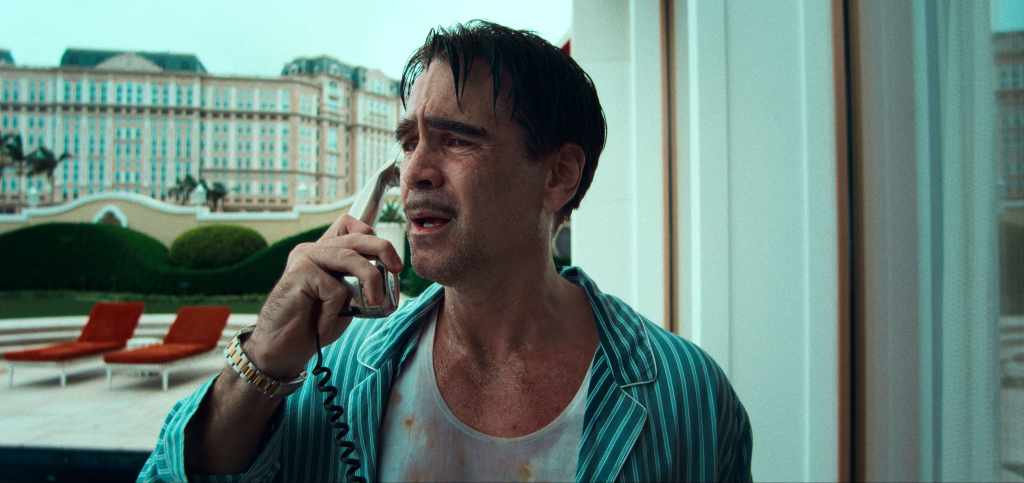
Colin Farrell steps into Ballad of a Small Player as Lord Doyle, a man living on borrowed time and dwindling luck in Macau’s sleepless casinos. Adapted from Lawrence Osborne’s novel, the film turns gambling into a portrait of guilt, addiction, and the false hope that one last win can fix what’s broken.
Doyle moves through the city’s neon haze, drifting between casino tables and hotel rooms while his debts close in. When he meets Dao Ming, a mysterious woman with her own regrets, the story shifts from a tale of survival to something more reflective. What begins as a pursuit of fortune becomes a reckoning with everything Doyle has lost, and what it costs to keep pretending.
From there, The Ballad of a Small Player moves beyond the shape of a gambling thriller. It turns Doyle’s downfall, and possible redemption, into a study of consequence and self-deception.
If you haven’t seen it yet, here’s the official trailer:

The Fall and the Masquerade
On the surface, Lord Doyle is a high-stakes gambler hiding in Macau. In truth, he’s Brendan Reilly, a disgraced lawyer who once embezzled money from a client and lost everything. Now he hides behind fine suits and a fake title, convincing himself that luck can still turn in his favor. His ritual, a pair of “lucky” gloves, becomes a quiet symbol of how far his superstition has replaced reason.
A Ghost, a Woman, a Ritual
Fala Chen’s Dao Ming enters Doyle’s orbit with wounds of her own: guilt, loss, theft, and a longing to make things right. In her calm presence, Doyle sees the possibility of redemption. Yet as their connection deepens, the film leaves room for doubt, whether Dao Ming is truly real or simply the echo of Doyle’s conscience.

The Casino as a Mirror
Macau’s casinos are more than backdrops. Their glitter and noise reflect Doyle’s inner spiral, a place where greed and fleeting luck blur together. When his fortune briefly returns, he pays his debts and even earns a ban for being “too lucky.” But every victory feels temporary, as if he’s only delaying the inevitable.
The Ending Explained
In the final act, Doyle faces Cynthia Blithe (Tilda Swinton) at the tables one last time. He wins, but instead of celebrating, he refuses to play again. He burns his winnings, abandons his gloves, and walks away from the life that’s consumed him. The moment feels less like a triumph and more like a release, an acceptance that the chase has finally ended.
What It Means
Ballad of a Small Player isn’t really about cards or chance. It’s about the cost of denial. Doyle’s struggle is less against bad luck than against himself, his lies, his greed, his refusal to stop taking. Macau becomes a mirror of that inner wreckage, a place where ghosts of guilt and temptation never rest. Dao Ming represents the line between destruction and redemption, and Doyle finally chooses to step over it.
The Poster