

Prime Video’s Every Year After follows the same emotional story that made Carley Fortune’s Every Summer After a bestseller, but it doesn’t tell it exactly the same way. Several characters receive expanded roles, major storylines are invented for television, and the finale reaches beyond the first novel to borrow material from One Golden Summer.
For readers who finished the series and are wondering what changed, the answer is quite a lot. The heart of Percy Fraser and Sam Florek’s story remains intact, but nearly every supporting character, several key plot points, and even the ending have been reshaped for television. Some of those changes help translate an internal novel into a visual medium. Others create entirely new storylines that never existed on the page, giving secondary characters larger arcs and providing the series with material that can carry future seasons.
What Changed Between Every Year After and Every Summer After?
At its core, both versions tell the same story. Percy Fraser returns to Barry’s Bay after learning of Sue Florek’s death. The trip forces her to confront her unresolved feelings for Sam, the mistakes that ended their relationship, and the secrets she spent years avoiding.
The biggest differences come from the show’s decision to expand the world around Percy. Characters who were relatively minor in the novel become central players, while several television storylines are completely original creations. The series also lays groundwork for future seasons by incorporating material from Carley Fortune’s later novel One Golden Summer.

Percy Fraser’s Story Is Largely Intact, But Important Details Change
One of the most noticeable differences involves Percy’s career.
In Every Summer After, Percy works as a senior editor at a decor magazine called Shelter. The job reflects one of the novel’s recurring themes: Percy abandoned her dream of becoming a writer and settled into a career that felt safer and more practical.
The series changes her profession entirely. Television Percy writes obituaries for a newspaper. While the change creates an interesting parallel between her work and the emotional story she is living through, it removes an important part of the novel’s exploration of creative ambition and regret.
Percy’s anxiety is also handled differently.
The novel presents her panic attacks as deeply internal experiences connected to grief, guilt, and the eventual revelation about Charlie. The series makes them far more visible. Scenes such as Percy becoming overwhelmed while swimming and being rescued by Charlie are original to the adaptation.
Another major change involves how Percy arrives in Barry’s Bay. In the novel, she comes alone. In the series, she arrives with Chantal, a decision that reshapes much of the present-day storyline.

Chantal Becomes One of the Show’s Biggest Additions
No character changes more dramatically than Chantal.
In the novel, Chantal exists mostly off-page. She is Percy’s best friend, but she never participates directly in the Barry’s Bay storyline. Percy faces the emotional fallout of returning to the lake largely on her own.
The series completely reimagines her role.
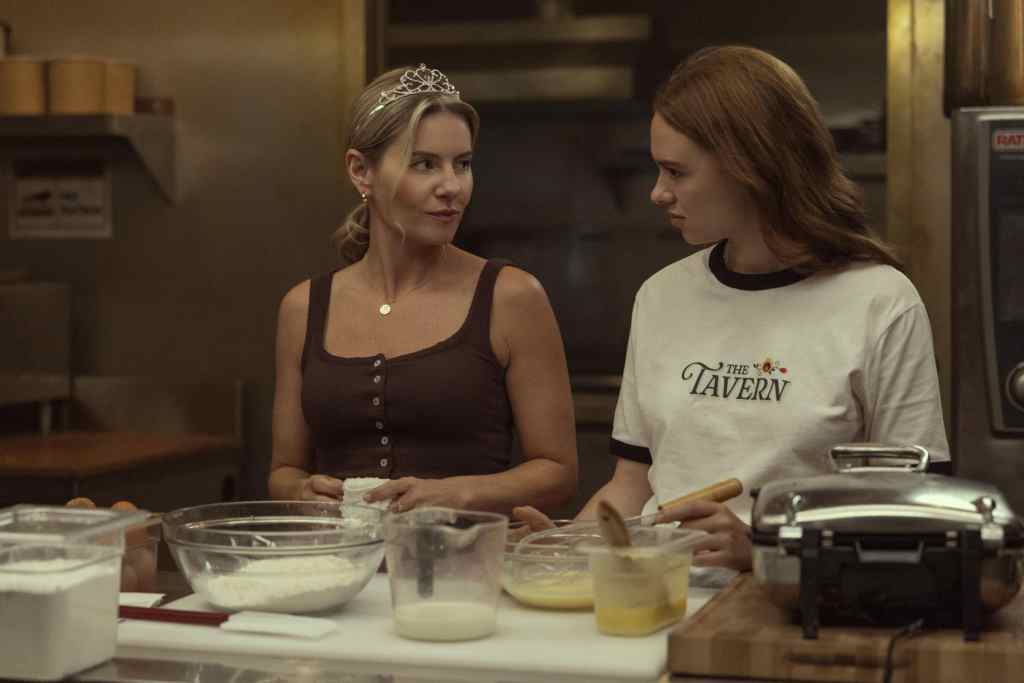
Chantal travels with Percy, meets the Floreks, becomes involved in the will reading, develops feelings for Jordie, questions her engagement to Drew, and receives an entire emotional storyline separate from Percy’s.
Everything involving Chantal and Jordie is new. Her engagement crisis is new. Her role during Sue’s funeral week is new. The adaptation essentially builds a second lead character out of someone who remained mostly in the background of the novel.
Drew also receives significantly more attention. In the book, he barely registers as a presence. In the series, he travels to Barry’s Bay and becomes part of the unfolding drama.

Sam Florek’s Story Stays Familiar, But Taylor Changes the Dynamic
Sam remains one of the characters most faithfully adapted from the novel.
The reserved personality, dry sense of humor, and lingering heartbreak all survive the transition from page to screen. However, the handling of Taylor changes significantly.
In the novel, Taylor appears during the famous Tavern sequence after Sam and Percy reconnect over drinks. Her arrival creates immediate tension and forces Percy to confront the reality that Sam has built a life without her.
The series introduces Taylor earlier and gives her a much larger presence. Rather than functioning primarily as an obstacle to Percy and Sam’s reunion, she becomes a more developed character with her own perspective.
The breakup itself also changes.
In the book, Sam reveals he ended things with Taylor after dropping her off. In the series, the breakup becomes a much larger story beat. Sam ultimately decides not to propose, creating a dramatic moment that never occurs in the novel.

Charlie Florek Receives Major New Material
Charlie may be the character most altered by the adaptation.
The novel presents him as charming, frustrating, selfish, and deeply complicated. Much of his characterization comes through Percy’s observations and the lingering impact of his choices.
The series adds entirely new layers.
One of the biggest additions is Charlie’s revelation that he helped finance Sam’s medical education as a form of penance. That detail does not exist in the book and gives the brothers’ relationship a different emotional foundation.
The famous shed sequence is also original to the series.
Rather than gradually working through their history over multiple conversations, Charlie and Percy are physically trapped together and forced into the confrontation. It’s a more overtly television-friendly way of resolving years of tension.

What Really Happened Between Percy and Charlie?
The central secret remains the same in both versions.
After Sam ended their relationship during the summer of 2016, Percy was devastated. Charlie became the person helping her through the aftermath. Eventually, they slept together once and agreed never to tell Sam.
The difference lies in how the story reaches that revelation.
The novel spends far more time developing the emotional bond that formed between Percy and Charlie after Sam’s departure. Charlie becomes her support system during one of the most painful periods of her life. Charlie also tells Sam he slept with Percy during Christmas break of their first year of university, months after Sam had broken up with Percy. Charlie told him during the holiday when they both came home from school, thinking it might help Sam understand why Percy pushed him away after the email breakup.
The series condenses much of that emotional development into a shorter collection of flashbacks. The reveal still lands, even though is Percy confessing to Sam, but it arrives with less of the moral ambiguity and emotional complexity that Fortune spent hundreds of pages building.
Delilah and Jordie Become Much Bigger Characters
Delilah undergoes one of the adaptation’s largest transformations.
In the novel, she is primarily a figure from Percy’s past. Their friendship, the pregnancy storyline, and the unresolved feelings between them all matter, but her present-day role is relatively limited.
The series turns her into a co-lead.
She organizes Sue’s memorial, struggles through a failing marriage, receives new storylines involving her prenup, reconnects with Charlie, bonds with Chantal, and ends the season on a very different emotional path than the version readers know.
Jordie receives a similar expansion.
While he exists in the novel, he is largely a supporting player. The series gives him professional struggles, romantic storylines, emotional depth, and a far greater role in the overall narrative.

Sue Never Leaves Percy the Tavern in the Book
Perhaps the single biggest plot invention involves Sue’s will.
In Every Summer After, Sue never leaves the Tavern to Percy.
The Tavern belongs to the Floreks. Percy has emotional ties to it because she worked there as a teenager, but ownership is never part of the story.
The series changes everything by making Percy the beneficiary.
From a television standpoint, the decision creates immediate conflict, forces Percy and the Floreks to remain connected, and provides a practical reason for her continued presence in Barry’s Bay.
It also fundamentally changes the power dynamics. Book Percy returns as a grieving guest. Television Percy leaves as a business owner.
How the Ending Differs From the Book
The ending of Every Summer After is surprisingly simple.
After the truth comes out and emotions finally settle, Percy and Sam find their way back to one another. The final chapter closes with the possibility of a future together.
The series reaches that point but keeps going.
The Tavern renovation storyline, Percy’s renewed connection to writing, and the broader focus on rebuilding are all additions created for television.
Most importantly, the finale introduces a major cliffhanger involving Charlie.
That storyline doesn’t come from Every Summer After at all.
How One Golden Summer Connects to the Finale
The final minutes of Every Year After borrow heavily from Carley Fortune’s 2025 novel One Golden Summer.
Unlike Every Summer After, that book focuses on Alice Everly, a photographer who returns to Kamaniskeg Lake and develops a romance with Charlie Florek.
Readers of One Golden Summer immediately recognize several details the series incorporates.
Charlie’s health concerns, his fear of following the same path as his father, and his eventual collapse are all rooted in material from that novel.
The famous speedboat photograph is also connected to Alice’s story.
In One Golden Summer, Alice took the photograph years earlier while spending a summer at the lake. The image becomes both a career-defining photograph and an important emotional symbol.
The series reassigns much of that material to Charlie while using it as a setup for future stories.
The result is a finale that closes Percy and Sam’s first chapter while simultaneously pointing toward Charlie’s.

Characters Missing From the Series
Several book characters are reduced or removed entirely:
- Finn, one of Sam’s friends, receives very little attention.
- Mason/Buckley is significantly condensed.
- Julien Chen, the Tavern chef, never receives the development he gets in the novel.
- Percy’s mother Diana plays a much smaller role.
Characters Added or Expanded for Television
Several storylines either did not exist in the novel or were dramatically expanded:
- Chantal’s entire Barry’s Bay storyline
- Chantal and Jordie’s relationship
- Drew’s expanded role
- The shed confrontation between Charlie and Percy
- The engagement ring subplot
- Sue leaving the Tavern to Percy
- Charlie financing Sam’s education
- Much of Delilah’s present-day story
What Every Year After Gets Right
Despite all the changes, the adaptation succeeds where it matters most.
The lake, the dock, the friendship bracelet, the ritual of sharing updates, the Banana Boat, and the feeling of summers that seem endless all survive the transition to screen.
Most importantly, the emotional core remains intact.
At heart, both stories are about two people whose lives were shaped by one another, who spent years carrying regret, and who finally get the chance to confront the past.
The series changes many details around the edges, but it never loses sight of that central relationship.


FAQ
- Is Chantal in Every Summer After? Yes, but only in a limited capacity. She remains largely off-page during the Barry’s Bay storyline and never accompanies Percy to the lake.
- Does Sue leave Percy the Tavern in the book? No. The Tavern inheritance is a television invention created for the Prime Video adaptation.
- Is Charlie’s heart attack from One Golden Summer? Yes. Charlie’s health concerns and collapse are drawn from material found in Carley Fortune’s novel One Golden Summer.
- Does Every Year After end the same way as the book? Not exactly. The series keeps the emotional reconciliation between Percy and Sam but extends the story and introduces material connected to One Golden Summer.
Key Details
- Release Date: 2026
- Episodes: 8
- Cast: Sadie Soverall, Matt Cornett, Aurora Perrineau, Abigail Cowen, Joseph Chiu, Michael Cooper Jr.
- Source Material: Every Summer After by Carley Fortune
- Additional Source Material Referenced: One Golden Summer by Carley Fortune
- Streaming Platform: Prime Video
- Genre: Romantic Drama