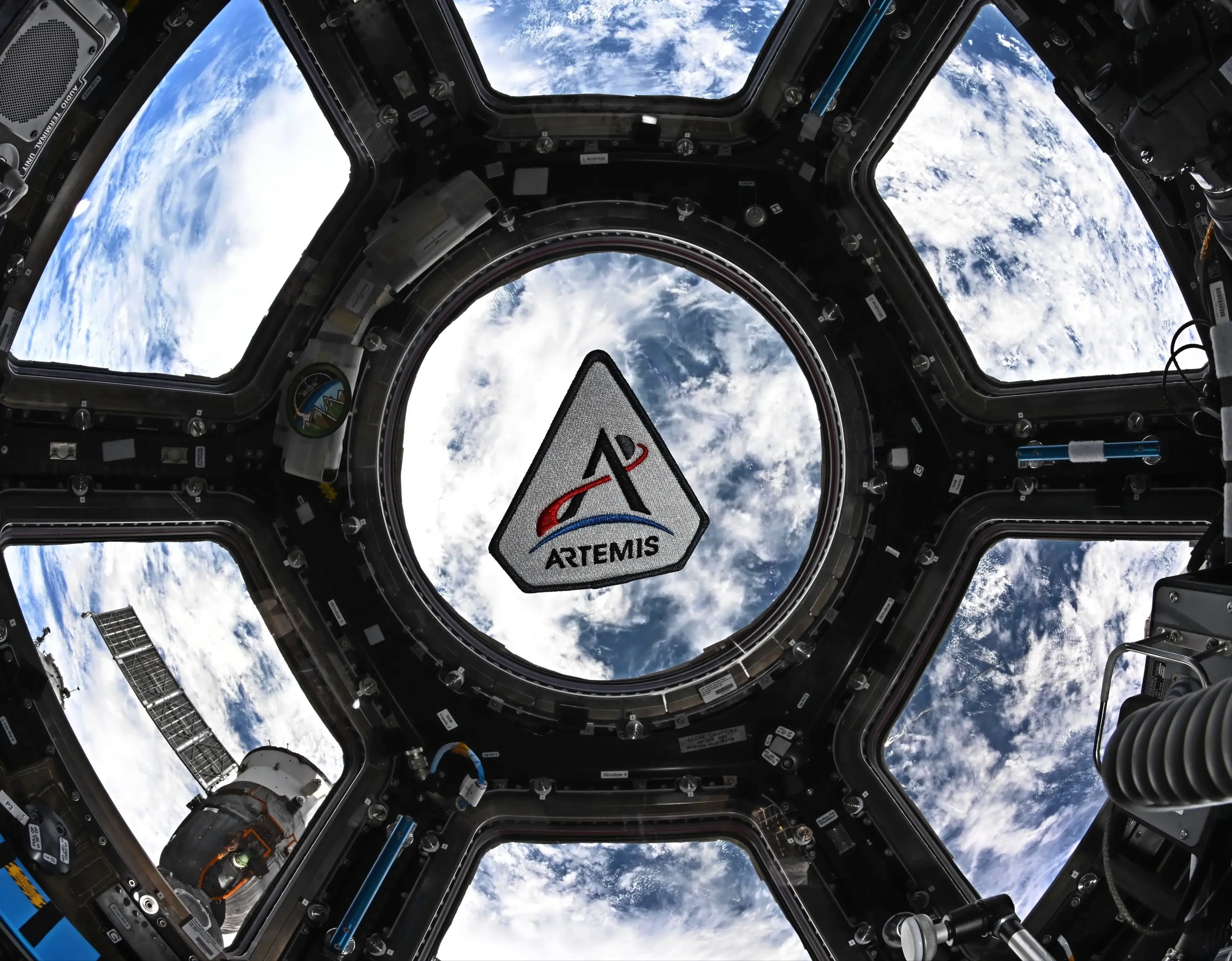
The Artemis II mission successfully launched on April 1, and after skipping the initial liftoff, Netflix confirmed it will livestream the crew’s lunar flyby.
The broadcast, which integrates the official NASA+ feed, goes live on April 6 as the Orion spacecraft reaches its closest approach to the Moon.
Humanity’s return to deep space is currently in its sixth flight day.
On April 1, 2026, NASA’s Space Launch System (SLS) rocket departed from Launch Complex 39B at the Kennedy Space Center. The mission is carrying four astronauts: NASA Commander Reid Wiseman, Pilot Victor Glover, and Mission Specialist Christina Koch, alongside Canadian Space Agency Mission Specialist Jeremy Hansen. While the departure was available via traditional news outlets, Netflix did not participate in the launch-day coverage.
The streamer has since updated its “NASA+ Live on Netflix” page to reflect the upcoming broadcast. This move follows a partnership established between Netflix and NASA in 2025, which has seen limited live activity until this high-profile lunar event.
In-Post Title: Artemis II Flight Schedule and Viewing Times
Global Livestream Times for the Lunar Flyby
The Netflix broadcast is scheduled to begin coverage at 1:00 PM ET on Monday, April 6. Because the Orion spacecraft is traveling on a fixed trajectory, the live window is tied to the vehicle’s physical position in space.
Subscribers can reference the following local start times to catch the feed:
- North America: 10:00 AM PT | 11:00 AM MT | 12:00 PM CT | 1:00 PM ET
- South America: 2:00 PM BRT
- UK & Europe: 5:00 PM UTC | 6:00 PM BST | 7:00 PM CEST
- Middle East & India: 9:00 PM GST | 10:30 PM IST
- Japan: 2:00 AM JST (Tuesday, April 7)
- Australia: 3:00 AM AEST (Tuesday, April 7)
- New Zealand: 5:00 AM NZST (Tuesday, April 7)
The mission marks the first time humans have traveled beyond low Earth orbit since Apollo 17 in 1972.
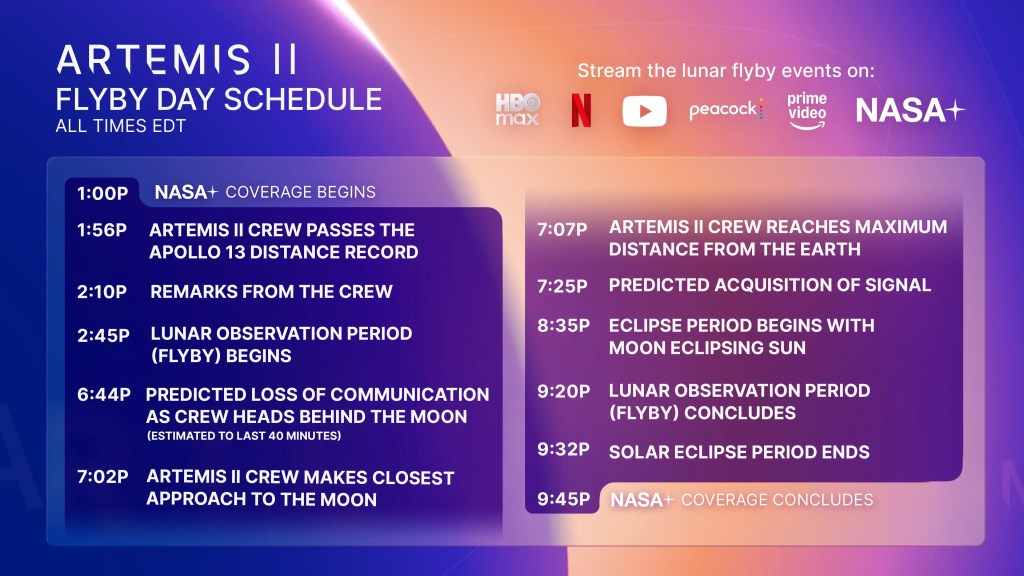
Outside of Netflix, NASA is providing a massive multi-platform distribution for the event. Viewers can also access the live lunar flyby via NASA+, Amazon Prime Video, Hulu, HBO Max, Apple TV, Roku, and the agency’s official YouTube channel, ensuring global access as the crew reaches their historic milestone
Mission Progress: Breaking Records on the Far Side
The Orion spacecraft officially entered the Moon’s sphere of influence at 12:37 AM EDT on April 6, the point where lunar gravity exerts a stronger pull on the vehicle than Earth’s. Astronaut Christina Koch confirmed the milestone via radio, noting that the crew was now “falling to the Moon rather than rising away from Earth.”
The flight path utilizes a free-return trajectory. Rather than firing engines to enter a closed orbit, Orion relies on the Moon’s gravity to slingshot the crew back toward Earth. During this maneuver, the spacecraft is scheduled to break the human spaceflight distance record previously held by the Apollo 13 mission in 1970, reaching a maximum distance of 252,760 miles from Earth at 7:07 PM EDT.
The livestream will cover the seven-hour observation period as the crew passes roughly 4,070 miles above the lunar surface. Viewers should expect a planned communications blackout of approximately 40 minutes starting at 6:44 PM EDT as the spacecraft traverses the far side of the Moon, where the lunar mass blocks direct radio signals to Earth. Toward the end of the observation window, the crew will also witness a solar eclipse from their vantage point as the Sun passes behind the Moon.
Artemis II FAQ
When is the Artemis II splashdown scheduled?
The Orion spacecraft is scheduled to return to Earth with a splashdown in the Pacific Ocean on April 10, 2026.
Who are the astronauts on the Artemis II mission?
The crew includes Commander Reid Wiseman, Pilot Victor Glover, and Mission Specialist Christina Koch from NASA, and Mission Specialist Jeremy Hansen from the Canadian Space Agency.
Why is this mission called a “flyby” instead of a landing?
Artemis II is a crewed test flight designed to verify spacecraft systems in deep space. A lunar landing is currently planned for the subsequent mission, Artemis III.
Key Details
- Release Date: Mission launched April 1, 2026; Netflix livestream April 6, 2026.
- Mission Duration: 10 days (Planned splashdown April 10, 2026).
- Cast: Reid Wiseman, Victor Glover, Christina Koch, Jeremy Hansen.
- Operator: NASA (National Aeronautics and Space Administration).
- Production Partners: Lockheed Martin (Orion), Airbus (European Service Module), Boeing (SLS).
- Source Material: Original NASA Artemis exploration program.
- Launch Site: Launch Complex 39B, Kennedy Space Center, Florida.