
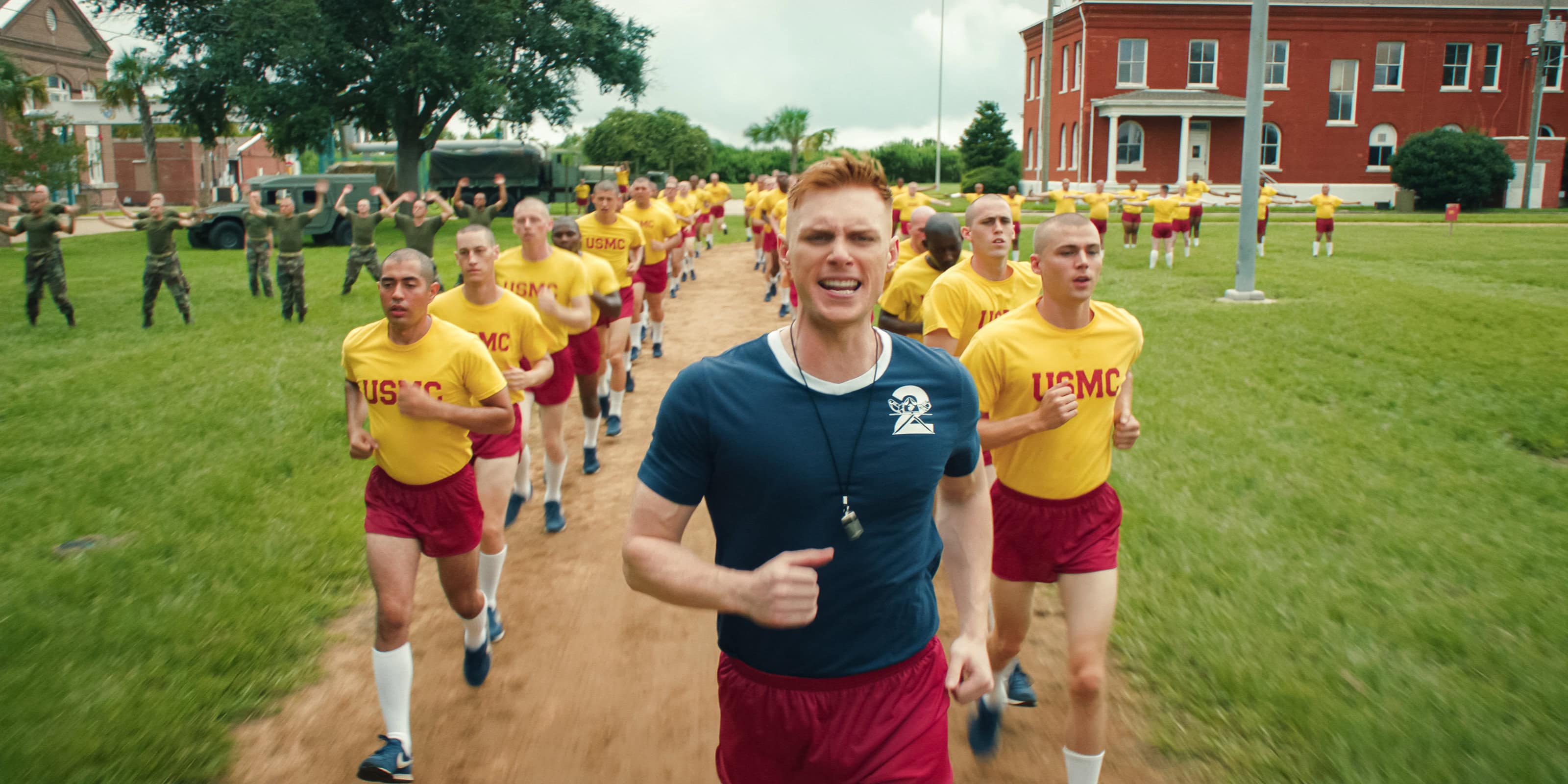
Netflix’s Boots lands Thursday, October 9, with an unflinching and often darkly funny look at U.S. Marine boot camp in the early 1990s, a time when being openly gay could end a military career overnight.
Adapted from Greg Cope White’s 2016 memoir The Pink Marine: One Boy’s Journey Through Boot Camp to Manhood, the eight-episode limited series follows Cameron Cope (Miles Heizer), a teenager desperate to prove himself in a world that tells him he’s not man enough.
Across eight episodes, Boots turns the grind of Parris Island into something more than a military rite of passage. It’s about survival, friendship, and the quiet war between who you are and who the institution demands you become.
Below you’ll find a full episode-by-episode recap and an ending explained that unpacks how Cameron’s story reframes ideas of courage and manhood.
Spoiler warning: Key plot points, deaths, and the finale are discussed in detail.
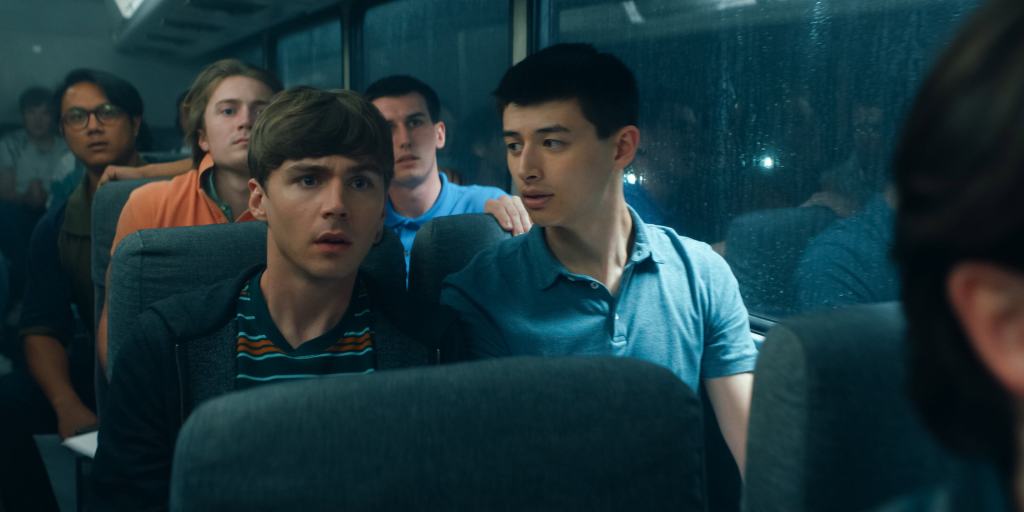
Episode 1 — The Pink Marine
The series opens with a question that shapes everything to come: what does it really mean to “become a man,” and where do you turn if you don’t fit the mold everyone insists on? In 1990, the U.S. Marine Corps barred openly gay men and women from serving. Same-sex relationships were criminalized under Article 125 of the Uniform Code of Military Justice, and there were no legal protections against discrimination. “Don’t Ask, Don’t Tell” was still three years away.
We meet Cameron Cope (Miles Heizer) just after high school graduation. For years he’s been bullied for being different, mocked for his music tastes (he loves Wilson Phillips), cornered and shaved in the school bathroom even on graduation day. To cope, he imagines himself split in two: the boy with his head shoved in the toilet, and the private self inside who knows what he feels and who he is. That inner voice, sometimes angel and sometimes devil, keeps getting louder the more he tries to ignore it.
While Cameron wonders what comes next, his best friend Ray McAffey (Liam Oh) calls with bad news. Ray planned to enlist in the Air Force, but was rejected because of a vision problem. Determined not to lose his friend, and fascinated by the Marines’ “buddy system,” which promises to keep enlisting friends together, Cameron decides to sign up for boot camp himself and hide that he’s gay. He’ll “lock it up,” a phrase that becomes his private mantra.
At the Marine Corps Recruit Depot in Parris Island, South Carolina, Cameron and Ray meet Staff Sgt. McKinnon (Cedric Cooper). The arrival is a shock. Drill instructors are loud, commanding, and unrelenting. They shout to break hesitation, call out mistakes publicly to force conformity, and use harsh nicknames to strip away ego. Inspections happen inches from recruits’ faces; exercises repeat until standards are met. It isn’t pure cruelty, the goal is to tear down individuality so recruits can be rebuilt as Marines able to function under pressure, but to a kid like Cameron, it’s terrifying.
Everything moves fast: scripted phone calls home, heads shaved, meals swallowed in minutes of “chug time.” Back in Texas, Cameron’s mother Barbara (Vera Farmiga) realizes too late what her son has done when she hears his recorded message. She drives to the recruiting office seeking answers but is charmed and deflected by the recruiter’s polished reassurances.
Cameron panics almost immediately, convinced the other recruits know he’s gay and that enlisting was a huge mistake. Ray tries to calm him but gets his own share of abuse, for his race and for simply being different. Still, we catch glimpses of Cameron’s lightness and humor. Instead of watching Full Metal Jacket like Ray suggested, he confesses he caught a rerun of The Golden Girls and identifies with Rose. The inner “angel” version of Cameron appears as a wry commentator in his mind, breaking tension and giving viewers relief.
Not every moment is cruelty. Sgt. McKinnon quietly brings proper shaving cream for dark-skinned recruits rather than forcing everyone to use the same harsh foam. Yet the tests are real: when a strength trial threatens to wash out weaker recruits, Cameron initially plans to fail. Seeing bullies target both him and a heavier classmate named John, he changes course, telling John no one’s packing bags today and pushing through the event.
Meanwhile, Captain Fajardo, one of the few female officers, put on leave a drill instructor after he attacks Ray, in a moment of explosive frustration. Cameron is shaken, if Ray can’t make it, how can he? His inner guardian voice fights to keep him grounded. Ray, humbled but still defiant, urges Cameron to stay: he belongs here just like everyone else, and Ray needs him too.
A new figure arrives at Platoon 2032: Sergeant Sullivan (Max Parker). The show signals immediately that Sullivan recognizes something in Cameron, an unspoken understanding. Without saying a word, we sense that Sullivan may also be gay, adding a subtle, charged layer to Cameron’s already perilous journey.

Episode 2 — The Buddy System
The second episode widens the world of Parris Island, showing how alliances can build strength,and how quickly the Corps breaks them apart.
We learn more about Sergeant Sullivan (Max Parker), the enigmatic new drill instructor. His file reads like a ghost story: a Recon Marine with covert ops experience, a duty station in Guam, three commendations for valor, and a Silver Star, yet most of his record is heavily redacted. Other instructors grumble about their company having a woman commanding officer, seeing it as part of a top-down effort to “change the Corps.” Sullivan, however, openly respects their Capt., praising her competence and understanding, a small but telling show of empathy toward someone who, like him, is a minority in the rigid Marine culture.
Among the new recruits, we meet John (Blake Burt) and Cody Bowman (Brandon Tyler Moore), twin brothers born into a long Marine tradition. John fears being the first man in their family to fail. Hoping to keep both of them alive and moving forward, he proposes a pact: he’ll help Cody with the academics and Cody can help him with the physical grind. Cody refuses; pride and old wounds run deep. Flashbacks fill in their history: as boys, Cody crawled into John’s bed during storms for comfort. Their father, abusive and openly disappointed in John, favored Cody and forced him to say cruel things to his brother. As teens, when John gained weight, their father beat Cody for “failing” to toughen him up, a warped way of turning brothers into rivals.
Ray (Liam Oh) meanwhile is driven by a single obsession: to be Honor Man, the top recruit of the platoon, a title his father once held. He spars with Cameron, trying to give his friend an edge in combat drills, but Sullivan spots it instantly. Later he warns Ray that Cameron could become a weakness if he keeps protecting him. Ray stays focused, convinced he needs this achievement to prove himself to his father.
Cameron, still keeping his sexuality hidden, starts to find small cracks in the isolation. He bonds with Nash (Dominic Goodman), a smart, affable reservist planning to add Marine service to his résumé when he heads to Howard University. Nash senses something different about Cameron but doesn’t press.
Cameron’s attention to detail gets him a new role: scribe for the drill instructors. During fire watch duty, the bullying recruit Slovacek tries to humiliate him by refusing to switch shifts. Cameron remembers Sgt. McKinnon’s early warning , “Only you can save your life”, and steels himself. After confiding with his inner “angel,” he finally fights back: he wakes Slovacek by dumping a bucket of urine on him. The entire platoon is punished, but the act shifts the balance. For once, Cameron is seen not as prey but as someone who can stand up to a bully. Even Sullivan takes quiet notice.
The episode culminates in the obstacle course, a defining rite. Cameron moves well, as do the Bowman twins, Slovacek, and Ray. The final test is the rope climb, pure exhaustion and willpower. Cameron makes it. Cody and Slovacek make it. Ray powers through. But John loses his grip and falls. The failure ripples: Sullivan demotes Ray from squad leader, citing not just John’s performance but also Ray’s distracting glances and open cheering for Cameron throughout training. To Ray’s shock, Sullivan names Cameron the new squad leader.
The promotion lands with complicated weight. Cameron has fought every day just to keep his secret and survive. Now he’s in a position of authority, recognized by a man who may quietly understand him, but also exposed to new scrutiny. The buddy system that brought him here suddenly feels fragile, and Ray, desperate to honor his father, now has to salute his best friend.

Episode 3 — The Confidence Course
Episode 3 folds together Marine Corps legend, brutal training, and Cameron’s fragile self-belief.
Early in the week the recruits study heroes of the Pacific, most notably Gunnery Sergeant John Basilone. In 1942 Basilone led two heavy-machine-gun sections through seventy-two straight hours of fighting. When his barrels overheated and no cooling water was left, he reportedly urinated on the guns to keep them firing. The story becomes a lesson in the Corps’ prized traits, confidence, grit, and determination.
For Cameron, those ideals still feel far away. He struggles with the small intimacies of communal life, even something as simple as using the bathroom under watchful eyes is a battle. A shake-up comes when a new recruit, Santos Santos, joins the platoon to fill the spot left by John Bowman. Santos quickly makes his ambitions clear. He needs new bootlaces, and as squad leader Cameron quietly swaps his own to help. It’s a small act of camaraderie that will matter later.
Meanwhile, a subplot unfolds back home. The recruiter who signed Cameron up begins a casual relationship with Barbara (Vera Farmiga), now working as a makeup seller. Hoping to help her business, he suggests a mothers’ support group on base. A misunderstanding follows: the women assume Barbara’s son has died in service, and sympathy fuels a spike in her sales, a bittersweet, slightly absurd moment that underscores how far removed she is from Cameron’s real struggle.
Back on Parris Island, Sergeant Sullivan receives a mysterious letter that darkens his mood. Just after the platoon finishes a spotless dorm inspection, he storms in and destroys their work, furious and looking for an outlet. He seems determined to break Cameron’s fragile footing as squad leader. Santos, shrewd and ambitious, spots his chance to impress.
The week’s trial is the confidence course, a series of daunting obstacles: the reserve course, the slide for life, and the towering stairway to heaven. Sullivan singles Cameron out, making him sit out or stumble through sections to chip away at his authority. On the final climb the swapped bootlace jams, threatening to strand Cameron mid-air. For a split second Sullivan helps, an unexpected flicker of empathy, but it vanishes as fast as it appears. “If there are no faggots in my Marine Corps,” he snarls, “why are you still here?” Cameron is demoted, and Santos is promoted to squad leader. Yet in an ironic grace note, Santos quietly hands Cameron a fresh set of laces, a small kindness after taking his role.
The moment, however humiliating, brings an unexpected release. Cameron isn’t a leader anymore, but he’s no longer invisible. The platoon offers quiet respect; someone finally acknowledges his effort.
Later, Cameron deepens his bond with Nash (Dominic Goodman). Sharing a smuggled sandwich, Nash admits his family doesn’t know he’s at boot camp; they believe he’s in Angola building summer camps. To them, the military is another system of oppression. Nash dreams bigger: he wants to fight for change from the inside, even run for president someday. Unlike Jesse Jackson, he says, he wants service on his record so voters will take him seriously.
The week ends with the tear gas test. Recruits enter a gas chamber masked; once inside, they’re ordered to remove protection and endure the burn before exiting. Sullivan reframes the lesson: strength isn’t about size, it’s about an inner fire, the confidence that nothing can break you. As the room fills with gas, men cough and flee. Cameron stays the longest, eyes streaming, proving a quiet toughness Sullivan hadn’t expected. For the first time, the sergeant seems impressed.
In the final scene we learn what rattled Sullivan: the letter was from Guam, warning him that NCIS is asking questions about his past and that he should watch his back. He burns the note to ash, a hint that his own secrets may soon surface.

Episode 4 — Sink or Swim
Episode 4 dives into the hardest week yet, swim qualification, and the fragile pride driving Ray and Cameron.
It opens with a flashback to Ray’s childhood. His father once pulled him out of school mid-day after “an episode,” but refused to label it an illness. Concentration, focus, discipline, he told young Ray. If you master those, there’s no room for nerves. The mantra stuck, shaping Ray’s belief that weakness is fatal.
Back in the present, the platoon faces swim week, a mandatory test that decides who advances. Sullivan is privately weighing his own future: his reenlistment window is closing. Expected to stay a drill instructor, he hesitates, haunted by unfinished business in Guam.
Ray fails his first swim attempt and unravels. Flashbacks of his father blur with the present; Sullivan and McKinnon’s barking feels unbearable. Perfection has always been Ray’s armor, without it, panic floods in.
Cameron sees his friend slipping and decides to intervene. He concocts a rivalry prank to rally morale: steal their own toilet paper, blame the neighboring platoon, and spark a playful “war.” With Nash and Hicks, Cameron raids supplies and frames the other unit. When caught on watch, he takes the blame. Sullivan saw them that night but said nothing, for now.
Morale briefly rises, but the week turns harsh. Captain Fajardo conducts an inspection; the platoon fails. Furious, McKinnon trashes their spotless barracks. During the chaos he finds Nash’s private notebook, filled with sharp, and often cruel, observations about everyone, including McKinnon and Cameron. He labels Cameron “not Marine material” and “kinda faggy,” a cut that lands hard.
Meanwhile, Sullivan meets with a lawyer about his reenlistment. Three months earlier in Guam, something went wrong; staying may carry risk. When he tells Captain Fajardo he plans to leave, she urges him to reconsider: he’s exactly the kind of Marine she’s trying to build at Parris Island.
Ray’s past keeps surfacing. Another flashback shows his father confessing that even he nearly washed out before earning Honor Man. You can’t let anyone see weakness, he warned. Lock it up. Overcome. It’s the same creed Ray is now drowning under.
That night the recruits plan their big strike on the rival platoon, clog toilets, steal their flag, spark a full prank war. Ray, Santos, Ochoa, and Hicks move out, but Cameron is missing. Sullivan has intercepted him, dragging him to the dumpsters where their hoarded toilet paper sits.
What follows is the episode’s emotional core. Cameron admits the prank wasn’t sabotage; it was loyalty. Ray needed a win, and he wouldn’t let his friend sink. He says he’d rather fail himself than watch Ray fail. Sullivan counters: It doesn’t matter what I think. It matters what you think. Will you surrender when it’s hard, to your brothers, your future, your country? Cameron answers quietly but firmly: he wants to be a Marine; he belongs here.
For the first time, Sullivan speaks without venom. He tells Cameron to stop seeing himself as less than and to claim his place, the exchange feels like hard-earned respect.
By the end of the week, Sullivan signs his own reenlistment papers, choosing to stay in the Corps. Just as he does, NCIS investigators arrive at Parris Island, hinting that his murky past in Guam may be catching up with him.
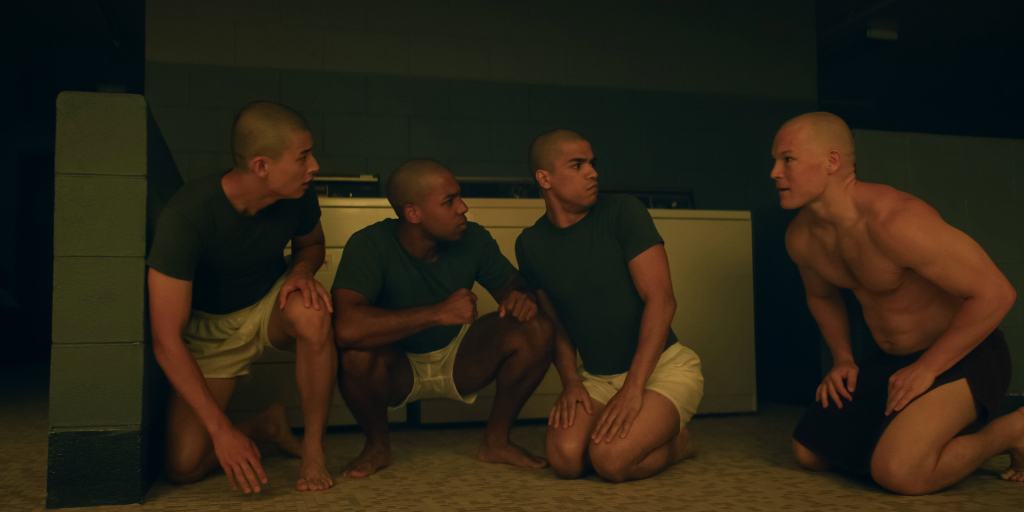
Episode 5 — Bullseye
The episode opens in chaos: a drill instructor performs CPR on a fallen recruit as medics rush in. Then the timeline jumps back two weeks to show how the platoon got here.
It’s rifle qualification week, the first time these young Marines will be trained as riflemen. The unit has begun to bond; the early awkwardness is fading into a rough brotherhood.
Back home, Barbara (Vera Farmiga) is still building her makeup business among Marine mothers. Her fragile charade cracks when Ray’s mother shows up at a sales event and blurts out that Barbara’s son is alive and in boot camp. The other women, who believed Barbara’s story that Cameron had died, are stunned, and Barbara’s sales pitch collapses.
At Parris Island, Sullivan formally decides to re-enlist, committing to stay a drill instructor.
Before the recruits fire live rounds for the first time, Hicks tells Ray the truth about the legendary toilet-paper raid, it wasn’t the rival platoon; Cameron orchestrated it. Cameron, rattled, loses focus on the firing line, but Sullivan quietly steadies him. Elsewhere, Ochoa proves a natural marksman but admits to Cameron he’s conflicted about killing. Cameron listens without judgment and helps him center.
Cameron and Ray finally clash. Cameron defends the toilet-paper stunt, Ray needed a boost during swim week. Ray accuses Cameron of secretly liking the role of the screw-up while Ray carries perfection. Cameron fires back: during swim week, their roles flipped, and Ray hated it. The fight turns ugly when Ray suggests Sullivan’s sudden support might be personal, hinting there’s “something” between the sergeant and Cameron. Punches fly.
The show pauses to meditate on masculinity. A man, it says, is someone who carries the weight in his pack even when it’s heavy, even when he doesn’t want it, out of love and sacrifice.
Meanwhile, McKinnon zeroes in on Nash, who’s been drifting. Nash talks about deliberately failing to escape the Corps. McKinnon warns: if Nash sinks on purpose, Slovacek will go down with him, only he will end up in prison. Nash shrugs that he isn’t responsible for others. McKinnon snaps back: That’s exactly what a Marine is, responsible for more than himself. Nash has talent but no commitment, ambition without sacrifice. McKinnon challenges him to face his real enemy: his own fear.
Sullivan’s past finally surfaces. NCIS calls him in about his time in Guam under Major Aaron Wilkinson, now investigated for misconduct and sodomy. Sullivan denies any relationship and insists he isn’t homosexual. The moment is tense; we know the cryptic letter he burned was signed “W.” At the agent’s request, Sullivan strips off his shirt to reveal a “Semper Fi” tattoo over his heart.
Back on the range, Ochoa wins top marksman and earns the rare reward of a call home. Nash shoots well enough to stay, saving Slovacek’s spot too. But when Ochoa phones, a man answers instead of his wife. Shaken, Ochoa barely has time to process before Howitt, a drill instructor, jokingly needles him about the call. Ochoa snaps, yelling, then suddenly collapsing. The platoon watches in horror as CPR begins, medics rush in, and the screen cuts to black.

Episode 6 — The Things We Carry
Word of Ochoa’s sudden death spreads fast across Parris Island, and mutates as it travels. Other platoons whisper half-truths and rumors. We get our first glimpses beyond Platoon 2032: a female training company grappling with its own hardships, and the unit where John Bowman was transferred after his fall. For 2032, the fragile brotherhood they’d built cracks. The loss has hollowed them out.
Drill Instructor Howitt is suspended pending review, but his shock is clear; Ochoa’s death hasn’t simply rolled off him the way so many tragedies do in the Corps. Sgt. McKinnon and Sullivan push the platoon to keep moving, yet it’s obvious the recruits can’t advance without first grieving.
It’s maintenance week, long hours of scrubbing and chores. Amid the monotony, Cameron and Ray finally reconcile. Ray admits the truth about his failed Air Force Academy dream: it wasn’t bad eyesight, it was pressure. The drive to be perfect broke him; he had an episode he couldn’t hide. Cameron is hurt, why could Ray trust him with nothing but still expect Cameron to hold his own secret? Ray apologizes. Cameron, calmer now, says they’re changing, and that’s good: “We’re killing our old selves to become better ones. It hurts, but it’s good.”
Meanwhile, Nash and Santos process Ochoa’s death through anger. They blame race and systemic bias, pointing to Howitt’s treatment. When the autopsy clears Howitt, citing a preexisting heart condition Ochoa hadn’t disclosed, the anger only deepens.
The episode shifts to Sullivan’s past, finally filling in his mystery. In Guam, he’d fallen in love with Major Aaron Wilkinson. They met secretly off base, exchanged “I love you,” and even got matching “Semper Fi” tattoos over their hearts. Wilkinson dreamed of living openly after service; Sullivan hesitated. A friend, Maitra, warned him: rumors were spreading about Wilkinson being gay. Staying close would draw suspicion. Sullivan pulled back, called in a favor to transfer off the island, and told Maitra he’d made a clean break, officially framing Wilkinson’s affection as an unwanted advance. It was a survival move, but one that left deep scars. That’s how Sullivan arrived at Parris Island: guarded, closeted, and carrying regret.
Back in the present, the platoon spirals. Anger boils over into a food fight in the mess hall. McKinnon, recognizing their need to mourn, calls in the base chaplain. Nash confesses guilt over what he’d written about Ochoa in his notebook. He can’t rage at others when he’s furious with himself. Cameron admits he sensed Ochoa was hurting the night before and wonders if he could have done more.
Sullivan, in a rare act of compassion, hands out alcohol. The recruits pour one out for Ochoa, drink, and slowly let their guard down. Jokes return. Apologies land. By night’s end, the platoon begins to feel like a family again, bruised but bonded.
Meanwhile, Captain Fajardo confides in McKinnon: she knows NCIS is investigating Sullivan, suspecting he’s gay. McKinnon’s response is blunt, hedoesn’t care who he loves. He’s outraged that a Marine with a Silver Star is being judged for his private life.
The barracks finally get a new body: Jones, a recruit who immediately gives off the quiet signal that he, too, might be gay. His arrival is a reminder that the cycle keeps turning. new faces, new secrets, and the same heavy question of belonging.
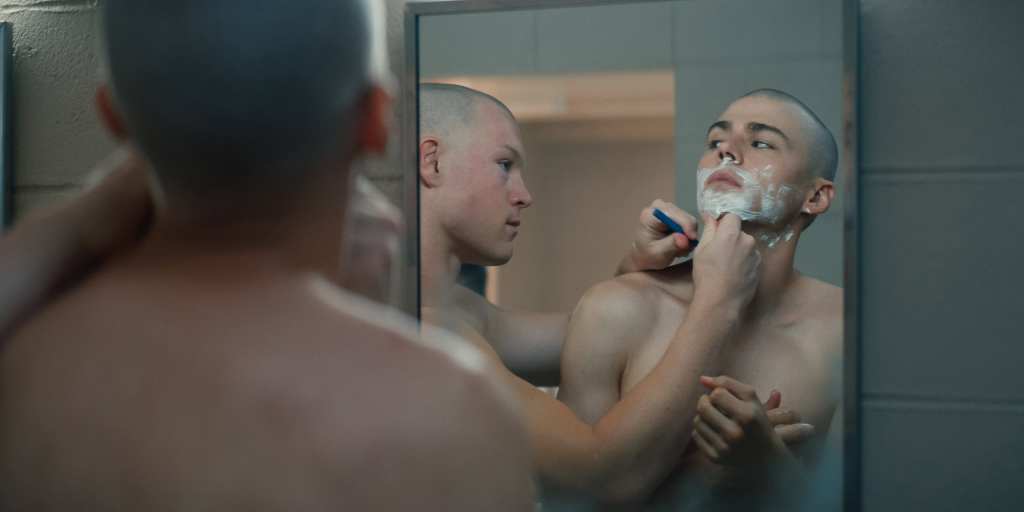
Episode 7 — Love Is a Battlefield
Episode 7 shifts the series into its most volatile mix of love, shame, and survival.
It opens with Sullivan attending the wedding of his old friend Maitra. There, he learns the truth: Maitra was the one who reported Major Wilkinson to investigators. As speeches drone on, Sullivan slips into an imagined conversation with Wilkinson, the man he once loved in Guam. Surrounded by medals, he feels hollow; despite every decoration, he realizes he’s still a stranger to love.
Back at Parris Island, the arrival of Jones unsettles Cameron. Jones is sharp, confident, and immediately sets off a quiet spark. While doing clerical work for the drill instructors, Cameron peeks into Jones’s file and learns he was previously in the “Crip” platoon after incidents of sleepwalking.
It’s hand-to-hand combat week, a brutal milestone. Santos, desperate to stay connected with his young daughter after rumors of a recruit’s death reached her, tries to trade food and favors for phone access. He’s caught, but Howitt, shaken and softened by Ochoa’s death, allows him a single birthday call, warning that if the call goes badly he must talk before doing anything rash.
Meanwhile, Ray comes down with an illness and spends time in the infirmary, where he reconnects with Alice, a fellow Marine he’d met earlier. They talk openly for the first time about families and dreams. Ray, usually guarded, seems smitten.
Cameron and Jones bond quickly. Jones admits he’s gay too and confides how exhausting it is to hide under constant scrutiny. He advises Cameron to act like he belongs anywhere, even when terrified. But he also picks up that Cameron is inexperienced, no gay friends, no real community. Jones coaches him to stand taller. Quietly, both suspect Sullivan might also be gay.
Sullivan notices their growing friendship and worries. He’s lived closeted for survival; a visible connection between two gay recruits could paint a target. So he strikes a dangerous bargain with Jones: if Jones wants out of the Corps, Sullivan can help secure a medical discharge. In return, Jones must push Cameron in the ring, hard, and drag the fight out until Cameron’s buried rage finally breaks loose. Sullivan frames it as toughening Cameron for combat.
Before the match, Jones tells Cameron they’ll stage the fight: Cameron should land one good punch, then will fold to make it look credible. But once they square off, Cameron realizes Jones lied. Jones comes at him full force. Years of bullying and boot camp humiliation explode out of Cameron; he fights with raw, frightening power, pounding Jones until McKinnon intervenes to stop it. It’s ugly but transformative, Cameron discovers a violent resilience he didn’t know he had.
The fallout hits Sullivan. NCIS formally arrests and charges Wilkinson under the Uniform Code of Military Justice, targeting him for his relationship and alleged “conduct unbecoming.” Reeling, Sullivan drunkenly calls Captain Fajardo from a bar, confessing that the matching “Semper Fi” tattoos were what NCIS used to confirm his intimacy with Wilkinson. Fajardo promises to stand by him and rails at the injustice, a decorated Marine punished simply for who he loves. But Sullivan, drunk and unraveling, stumbles outside and assaults a civilian, his controlled facade finally cracking.
Episode 8 — The Crucible
The finale puts everything the recruits have learned to the test in the Crucible, a grueling 54-hour trial that combines every skill taught at boot camp. It’s the last hurdle before earning the title Marine.
Jones returns to training, and Sullivan pointedly pairs him with Cameron. Jones seems distracted, almost resigned.
Back home, Ray’s mother visits Barbara, who is once again packing up to move. Barbara confesses a painful truth: she admits she tried to “toughen Cameron up” when he was little and often left him to fend for himself. Ray’s mother quietly tells her it’s never too late to be the mother he needs.
On the field, the Bowman twins learn their abusive father has died. They’re offered leave to attend the funeral and then rejoin training with another platoon. Cody wants to go; John refuses, saying this is where he belongs and he won’t honor the man who brutalized them. For the first time, Cody admits he needs his brother, but John stays.
Elsewhere, Ray helps Santos hide a bad knee so he won’t be dropped from training. Santos just wants to finish and maybe land a steady government job. Ray tapes and shields him quietly.
While resting, Cameron and Jones overhear Sullivan and Captain Fajardo. Fajardo tells Sullivan the fallout from his drunken bar fight, in which he assaulted a civilian, is severe: felony charges mean a dishonorable discharge and the end of his career. She urges him to fight, but Sullivan sounds finished.
During the march, Santos begins to falter under his heavy pack. One by one, Nash and other recruits pull gear from his ruck, lightening the load until everyone shares the burden. Together they get Santos through the Crucible, a simple, powerful moment of brotherhood.
The same morning Jones disappears, leaving his boots neatly outside the tent. Fearing he’s sleepwalking into the swamp, Sullivan goes after him. Cameron and Ray follow, refusing to leave anyone behind. Fajardo radios an order for only Sullivan to continue, but Cameron disobeys. Cameron tells Ray he’s got this now, proof of his growth, and goes on with Sullivan.
During the search, Cameron opens up: he stayed to be like Sullivan, strong, unflinching. He shares his own story of hiding and surviving. Sullivan, between the lines, confirms Cameron’s suspicion that he’s gay too. Eventually they find Jones, disoriented but alive. Cameron escorts him to medical aid, then asks Fajardo’s permission to finish the Crucible. He arrives at the finish line to cheers from his platoon, earning the title Marine.
Sullivan, humbled, tells Cameron his job was to prepare him, maybe too harshly at times, but everything came from wanting him ready. “You don’t need me anymore,” he says.
When honors are handed out, Nash is named Honor Man. Ray, who once needed to be first, finally lets go of perfection, and even earns a rare word of approval from his father. He also reconnects with Alice, who slips him her phone number. McKinnon proudly greets Nash’s parents.
Then comes a twist: Cameron is summoned to Captain Fajardo’s office, where his mother waits. Barbara reveals a paperwork bombshell, she falsified Cameron’s age on his kindergarten enrollment, which means his enlistment is legally invalid. She asks the Corps to release him.
Cameron retreats into quiet reflection with his inner “angel” self, the voice that’s guided him since childhood. He knows staying could mean slowly silencing that voice and losing the truest part of himself, just as the Corps broke Sullivan and nearly erased Jones. But he also sees how much he’s grown: stronger, braver, no longer the boy with his head shoved in a toilet. After sitting with that fear, he decides not to take the way out. He will stay and finish what he started, determined to hold on to his identity even as he earns the title Marine. Heartbroken but loving, Barbara signs the waiver, telling him that whatever he chooses, he will always be her son.
That night the newly minted Marines celebrate at a bar. Cameron and former bully Slovacek finally make peace. On a nearby TV, news breaks: Iraq has invaded Kuwait; President George H. W. Bush announces U.S. air and ground forces will deploy to Saudi Arabia. The question hangs, will this end the conflict or escalate into something worse?
The series closes with a quiet tribute:
“In memory of Norman Lear.”
A nod to the groundbreaking television creator and executive producer of the series, himself inspired to enlist after seeing a Marine Corps recruiting poster in World War II, whose legacy shaped how stories about courage and identity are told.
Ending Explained: Cameron’s Choice to Stay, and What It Means
The final hour of Boots isn’t a simple victory lap; it’s a reckoning with identity and survival inside an institution that, in 1990, still punished anyone who didn’t fit its narrow idea of masculinity.
Cameron’s mother arrives with a legal loophole that could free him: she once falsified his age, making his enlistment invalid. For the first time since arriving, Cameron has a real exit. His inner voice, the imagined “angel” self we’ve seen since Episode 1, warns what staying could cost: years of hiding, the slow death of authenticity, the fate of Sullivan and nearly Jones. Yet Cameron also sees how far he’s come. He’s no longer the boy shoved into a toilet. He has endured humiliation, learned to fight back, and found strength without surrendering kindness.
Choosing to stay isn’t about embracing the Corps’ prejudice; it’s about refusing to run from himself. Cameron decides to finish on his terms, believing he can hold on to his identity even as he earns the Eagle, Globe, and Anchor. His mother signs the waiver, heartbroken but proud, telling him he’ll always be her son.
Sullivan’s arc lands as a counterpoint. A decorated Marine undone by a system that labeled his love a crime, he tried to harden Cameron to survive what broke him. His downfall shows the real risk Cameron faces, but also why the choice matters: Cameron wants to claim strength without losing his core.
The TV in the bar showing Iraq’s invasion of Kuwait drives home the timing, these new Marines may soon face war. Boots ends not with uncomplicated triumph but with a nuanced idea of manhood: strength isn’t silence or conformity; it’s knowing who you are and standing there anyway.
The Poster

Key Details: Boots Netflix
- Based on: The Pink Marine by Greg Cope White
- Release date: October 9, 2025 (Netflix)
- Episodes: 8 (one hour each)
- Main cast: Miles Heizer, Liam Oh, Max Parker, Vera Farmiga, Cedrick Cooper, Ana Ayora, Angus O’Brien, Dominic Goodman, Kieron Moore, Nicholas Logan, Rico Paris, Blake Burt
- Additional cast: Brandon Tyler Moore, Zach Roerig, Anthony Marble, Joy Osmanski, Ivan Hoey Jr., Logan Gould, Jack Kay, Troy Leigh-Anne Johnson, Jonathan Nieves, Brett Dalton
- Creator / Showrunner: Andy Parker & Jennifer Cecil
- Executive producers: Andy Parker, Jennifer Cecil, Norman Lear, Brent Miller, Rachel Davidson, Scott Hornbacher, Peter Hoar
- Studio: Sony Pictures Television



I freagin luuuuuuuuuuuv this show! Please bring it back for another season! The writing is brilliant, not to mention, my friend @dominic colon is one of the staff writers too!!!!!!!!!!!!!!! yeh! Latinos represented!!!!