

What happens when the sirens of Greek myth don’t sing sailors to their death, but lure people in with wealth, power, and a curated life?
That’s the question at the heart of Sirens, Netflix’s unsettling five-episode limited series created by Molly Smith Metzler. With striking performances, eerie visuals, and a story that walks a fine line between psychological drama and cautionary tale, Sirens isn’t just about who holds power; it’s about who controls the game board.
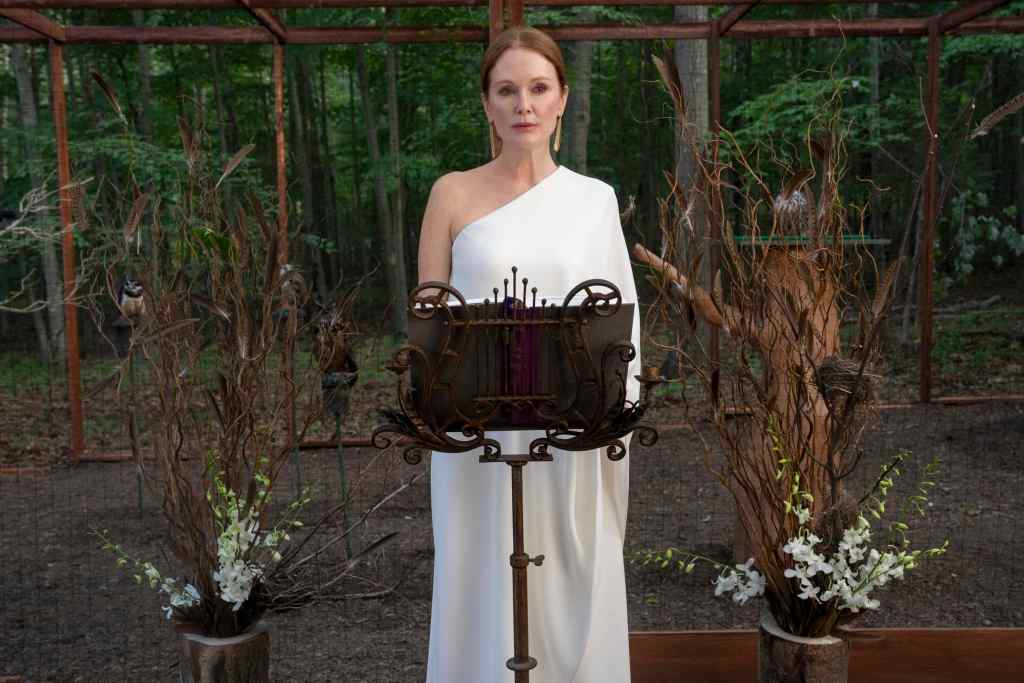
At the center is Simone (Milly Alcock), a young woman with a traumatic past who’s clawed her way into the glamorous world of Michaela “Kiki” Kale (Julianne Moore), a society figure who runs her home like an empire and treats her birds with more warmth than people. Simone begins as Kiki’s devoted assistant, hyper-competent, quiet, invisible, but when she falls into an emotional entanglement with Kiki’s husband Peter (Kevin Bacon), the balance begins to shift.
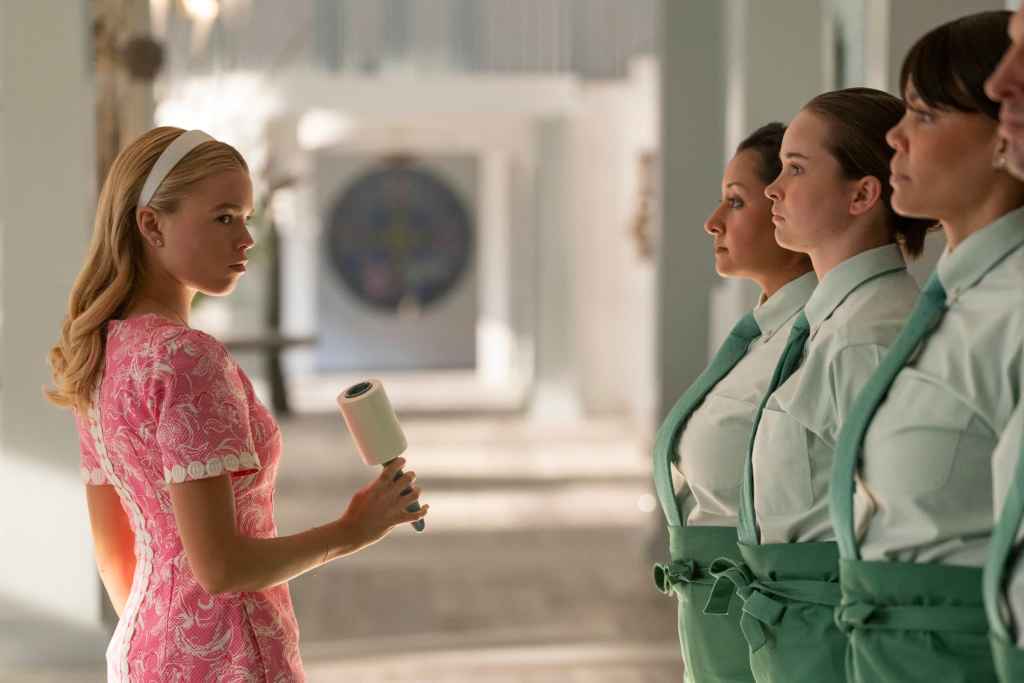
What starts as a misstep becomes an opportunity. Simone is fired and cast out, but instead of retreating, she repositions herself. She moves in on Peter’s affections and reclaims her place at the estate, not as a servant, but as its new queen. The transition is chilling not because Simone is cruel, but because she believes it’s survival. It’s what Kiki once did, after all. The cycle repeats.
But the true architect of all this? Peter.
While the series positions Kiki and Simone as the sirens, magnetic, mysterious, and dangerously alluring, it’s Peter who quietly sets the terms. He controls the money, the prenups, and the social access. He decides who gets in and who’s pushed out. Kiki became who she is because of him. Simone stepped into that space because he let her. Power doesn’t lie in seduction, it lies in who sets the stakes.

What Happens to Michaela?
After Simone replaces her, Michaela is forced to leave the home she curated like a stage set, every room, guest list, and bird enclosure a reflection of the life she built from scratch. But once Peter withdraws his affection and influence, the illusion crumbles. Her staff turns cold. Her curated power evaporates. We last see her on the ferry, not in rage or denial, but in quiet shock. She isn’t plotting revenge; she’s reckoning with the reality that she was never in control. The estate, the marriage, the status, it was all on loan. Michaela becomes a ghost in her own story, not because she lost, but because the game was never built for her to win.
Kiki’s own past reveals just how precarious her position always was. She came from poverty, built her life around reinvention, and once seduced Peter away from his first wife. She spent years curating a perfect image, a pristine house, a prestigious marriage, a private sanctuary of birds, but beneath that control was grief. She tried and failed to have children, and her care for birds became a quiet form of mourning and control. The estate wasn’t just a home. It was her identity.
Meanwhile, Devon (Megan Fahey), Simone’s estranged sister, serves as the show’s emotional compass. A recovering alcoholic and former addict, Devon arrives on the island hoping to pull Simone away from this toxic world and back to help care for their ailing father. But Devon isn’t just here to play savior, she’s battling her own pain. She sacrificed her youth to raise Simone after they lost their mother. She understands trauma not as theory, but as muscle memory.
Throughout the series, Devon is the only character who questions the system rather than trying to master it. Her journey is quieter but essential. By the end, she’s the one who walks away, not because she’s defeated, but because she refuses to become what this world demands. In a key moment, her father calls her a “good girl,” a line that echoes long after Simone ascends the social throne. Devon may not win in material terms, but she keeps her soul intact.
The series closes with Simone on the balcony, gazing out at the ocean like a mythic figure. But the haunting truth is, she’s not the monster. Not exactly. She’s a product of a system that rewards those willing to lose parts of themselves to stay afloat. In that sense, the show’s title doesn’t refer to one woman; it refers to an idea. Power disguised as affection. Control dressed up as security. And the myth that any of it is sustainable.

A Closer Look: Sirens in Greek Mythology
In Greek mythology, sirens were half-bird, half-woman creatures whose beautiful songs lured sailors to their doom. They were symbols of temptation, dangerous not for what they were, but for what they made people do.
Netflix’s Sirens flips that idea. There’s no magic melody, just desire. The show draws a direct line between classical myth and modern power dynamics. Kiki and Simone are the “sirens,” but they don’t sing. They offer something more intoxicating: validation, success, escape. And those who pursue it, ike Peter, Jose, or even Devon, aren’t innocent sailors. They’re complicit.
Sirens: Official Trailer, Cast, and Release Date Revealed for Netflix’s Dark Comedy Limited Series
The White Lotus Effect
If The White Lotus had a sister raised on Greek tragedy, it would be Sirens. Both series explore the rot beneath wealth and privilege, featuring ensemble casts, moral ambiguity, and cliffside aesthetics. But where The White Lotus leans into social satire, Sirens slips into psychological thriller territory. It’s less about who dies, and more about what people lose to stay relevant.
Sirens is a tight, well-acted, and unnerving meditation on who gets to hold power and what it costs. While its five episodes don’t demand a huge time investment, the emotional impact lingers. The show may not give you easy answers, but it leaves you with sharper questions about control, identity, and how far people will go to matter.
Series Details:
- Title: Sirens
- Creator: Molly Smith Metzler
- Platform: Netflix
- Episodes: 5
- Premiere: May 2025
- Genre: Psychological Drama / Limited Series / Myth-Inspired Fiction