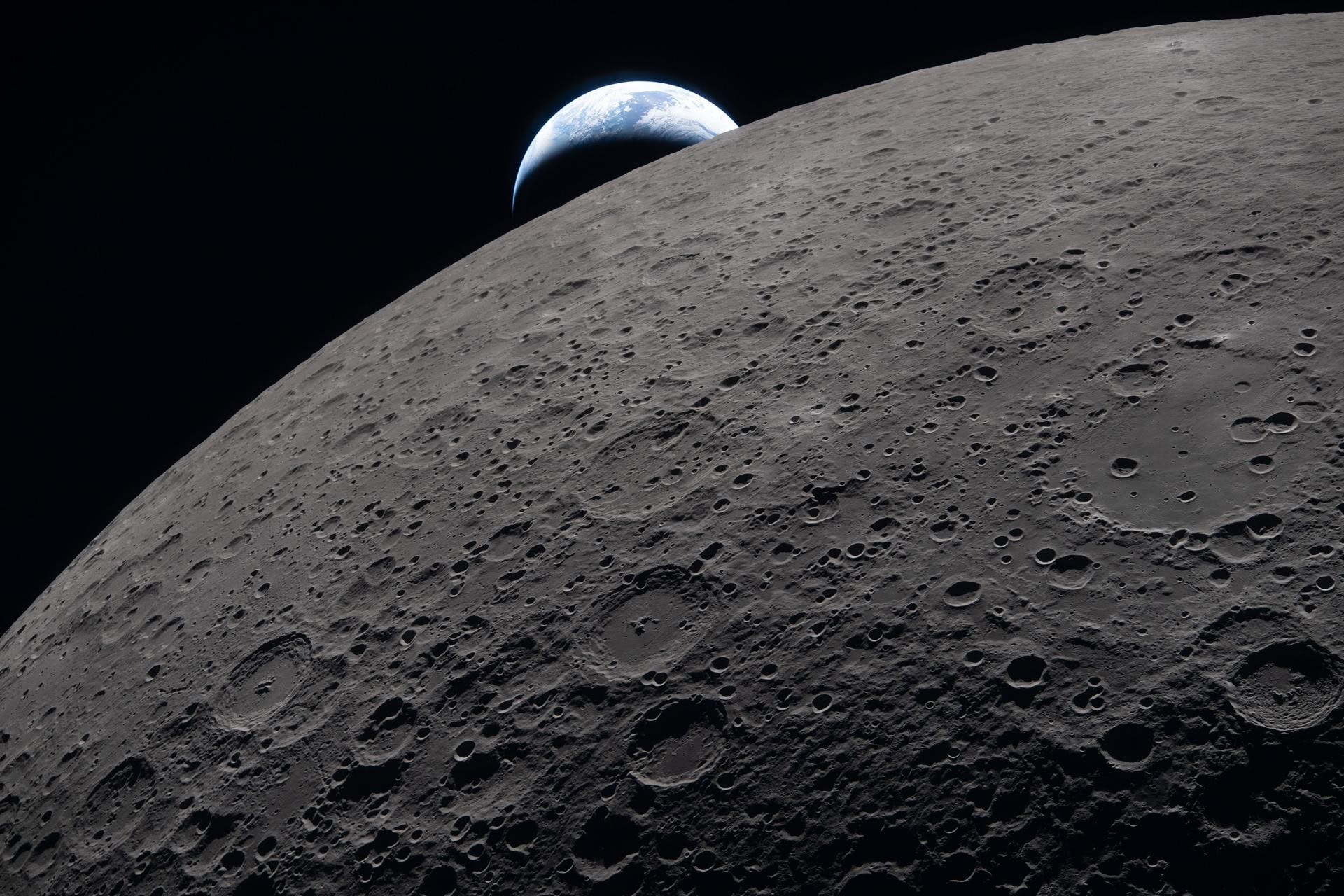
The Artemis II crew is scheduled to splash down in the Pacific Ocean off the coast of San Diego at 8:07 p.m. EDT (5:07 p.m. PDT) today, April 10, 2026.
This arrival marks the conclusion of a 10-day, 694,481-mile journey that sent humans around the Moon for the first time since 1972. NASA astronauts Reid Wiseman, Victor Glover, Christina Koch, and CSA astronaut Jeremy Hansen are currently completing their final trajectory corrections as the Orion spacecraft prepares for atmospheric entry.
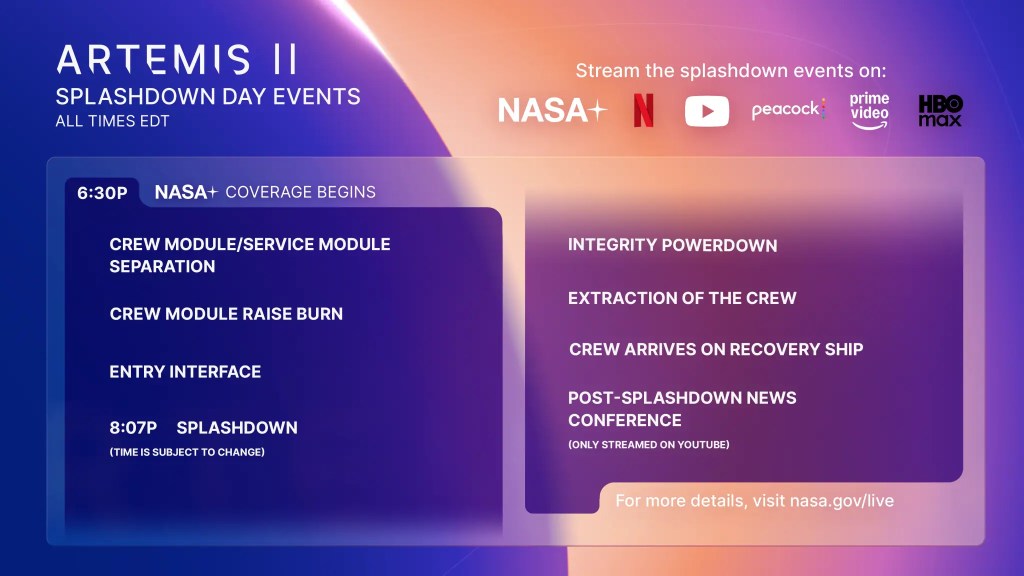
The Artemis II splashdown represents a pivotal moment for modern spaceflight, and for the first time, the recovery will be accessible through a massive array of mainstream digital platforms. While NASA+ remains the primary source for technical commentary, the agency has partnered with major streamers, including Netflix, Amazon Prime, Apple TV, HBO Max, YouTube, Discovery+, Peacock, and Roku, to broadcast the return. Live coverage is set to begin at 6:30 p.m. EDT, providing a continuous look at the descent, the communication blackout period, and the eventual recovery of the four-person crew by U.S. military teams.
Orbital Mechanics and the Final Burn
Success for this mission depended on the precision of the third return-trajectory correction burn, scheduled for 2:53 p.m., which was successful. This maneuver was not merely a course adjustment but a mechanical necessity to ensure Orion hits the “entry corridor” at the exact angle required to avoid either skipping off the atmosphere or burning up upon entry. At the start of Flight Day 10, the crew was approximately 61,326 miles from Earth, traveling at speeds that will eventually reach 35 times the speed of sound.
This mission has been defined by its technical stability. Unlike the uncrewed Artemis I, this flight required the crew to directly operate and interact with Orion’s systems in a deep-space environment. The shift from the lunar flyby on Day 6 to the current re-entry phase demonstrates the spacecraft’s ability to maintain life support and navigational integrity over a high-mileage trajectory.
The Re-entry Timeline and Sonic Booms over California
The descent sequence begins in earnest at 7:33 p.m. with the jettisoning of the service module. This leaves the crew module and its heat shield to face temperatures nearing 3,000 degrees Fahrenheit. One of the most intense phases occurs at 7:53 p.m. when Orion hits the upper atmosphere at 400,000 feet. This initiates a six-minute communications blackout, a standard yet always tense interval during which plasma buildup prevents radio signals from reaching Mission Control.
Residents in Southern California may experience the return through their senses, even if they cannot see it. According to the U.S. Geological Survey, a sonic boom is expected as Orion decelerates through the atmosphere. This auditory and physical phenomenon could be felt across the region between 5:00 p.m. and 5:15 p.m. local time. While the capsule’s visual streak may be obscured by daylight or by the trajectory, the pressure wave remains a tangible indicator of the spacecraft’s arrival.
Parachute Deployment and Recovery Logistics
Orion’s deceleration is a multi-staged mechanical process. At 22,000 feet, two drogue parachutes will deploy to stabilize the capsule. These are followed at 6,000 feet by the three main parachutes, which must slow the craft from 136 mph to a survivable 20 mph at splashdown. The physical toll on the astronauts during this time is significant, with the crew expected to experience up to 3.9 Gs during the entry profile.
Once the capsule hits the water, the focus shifts to the USS John P. Murtha. NASA and U.S. military recovery teams will extract the crew within two hours of splashdown. The process involves moving the astronauts from the capsule to an inflatable raft, then using helicopters to transport them to the ship for medical evaluations. This transition from microgravity to Earth’s gravity is often the most physically taxing part of the mission for the crew.
FAQ
- Where can I watch the Artemis II splashdown live? The event will be streamed on NASA+, Netflix, Amazon Prime, Apple TV, HBO Max, Discovery+, Peacock, and Roku starting at 6:30 p.m. EDT.
- Will the Artemis II splashdown be visible from land? While the spacecraft may not be clearly visible from Southern California due to timing and altitude, a sonic boom is expected to be heard and felt in the region between 5:00 p.m. and 5:15 p.m. PDT.
- What happens to the astronauts immediately after splashdown? The crew will be extracted from the Orion capsule, moved to an inflatable raft, and then flown by helicopter to the USS John P. Murtha for medical checks before returning to Houston.
Key Details
- Release Date: April 10, 2026 (Splashdown)
- Splashdown Time: 8:07 p.m. EDT / 5:07 p.m. PDT
- Duration: 10 days
- Cast (Crew): Reid Wiseman, Victor Glover, Christina Koch, Jeremy Hansen
- Creators/Agency: NASA (in partnership with CSA, ESA, and JAXA)
- Studio (Recovery Vessel): USS John P. Murtha
- Source Material: Artemis II Mission Press Kit
- Filming Location (Recovery Zone): Pacific Ocean, off the coast of San Diego